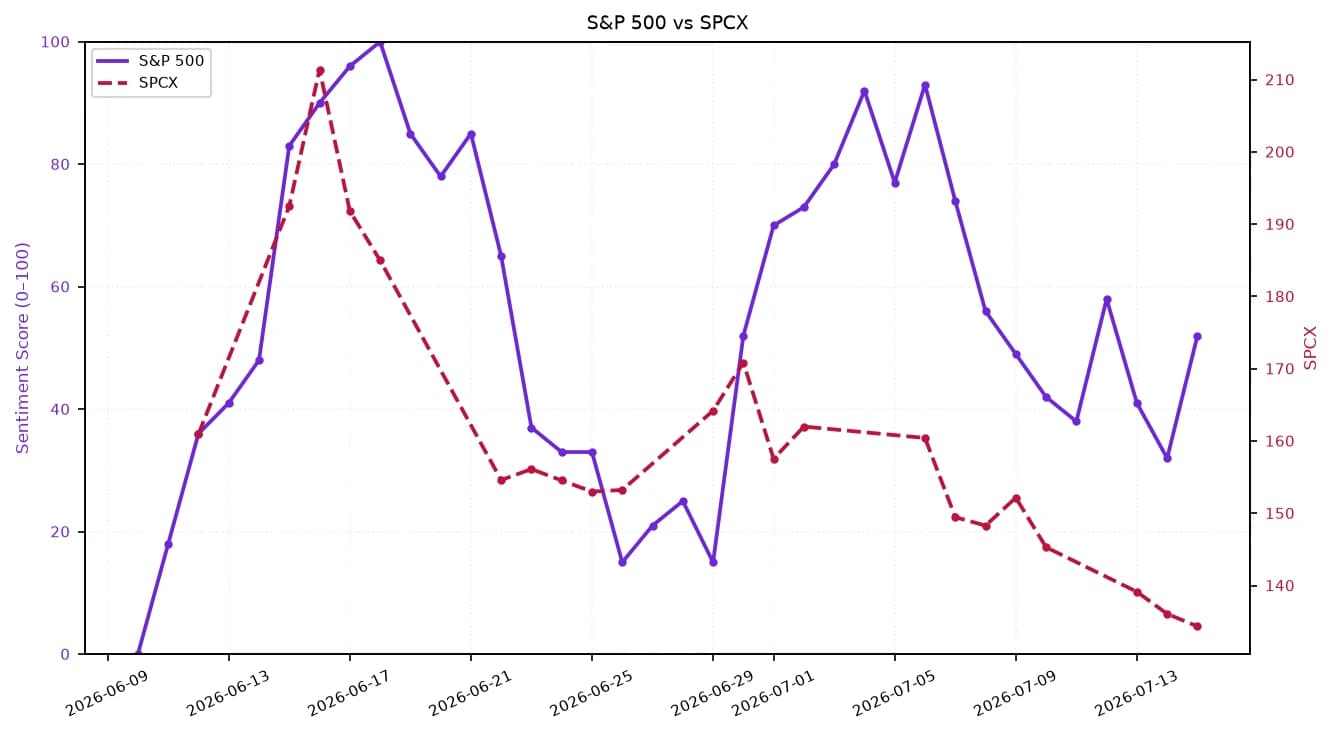
Equity benchmarks linked to Europe and the United States are extending gains as bond markets settle into a fragile equilibrium, with the U.S. 10-year Treasury yield holding near 4.96% and the 2s/10s curve at about 25 basis points.
SPY and QQQ Rise as 10-Year Yield Holds Near 4.96%
That matters because the rally is being driven less by fresh economic strength than by the market’s view that policy is close enough to restrictive levels to slow inflation without forcing a deeper downturn. For investors, the implication is a familiar one: lower real-rate pressure supports growth and long-duration assets, but the trade is still vulnerable if yields back up or if incoming data revive recession fears.
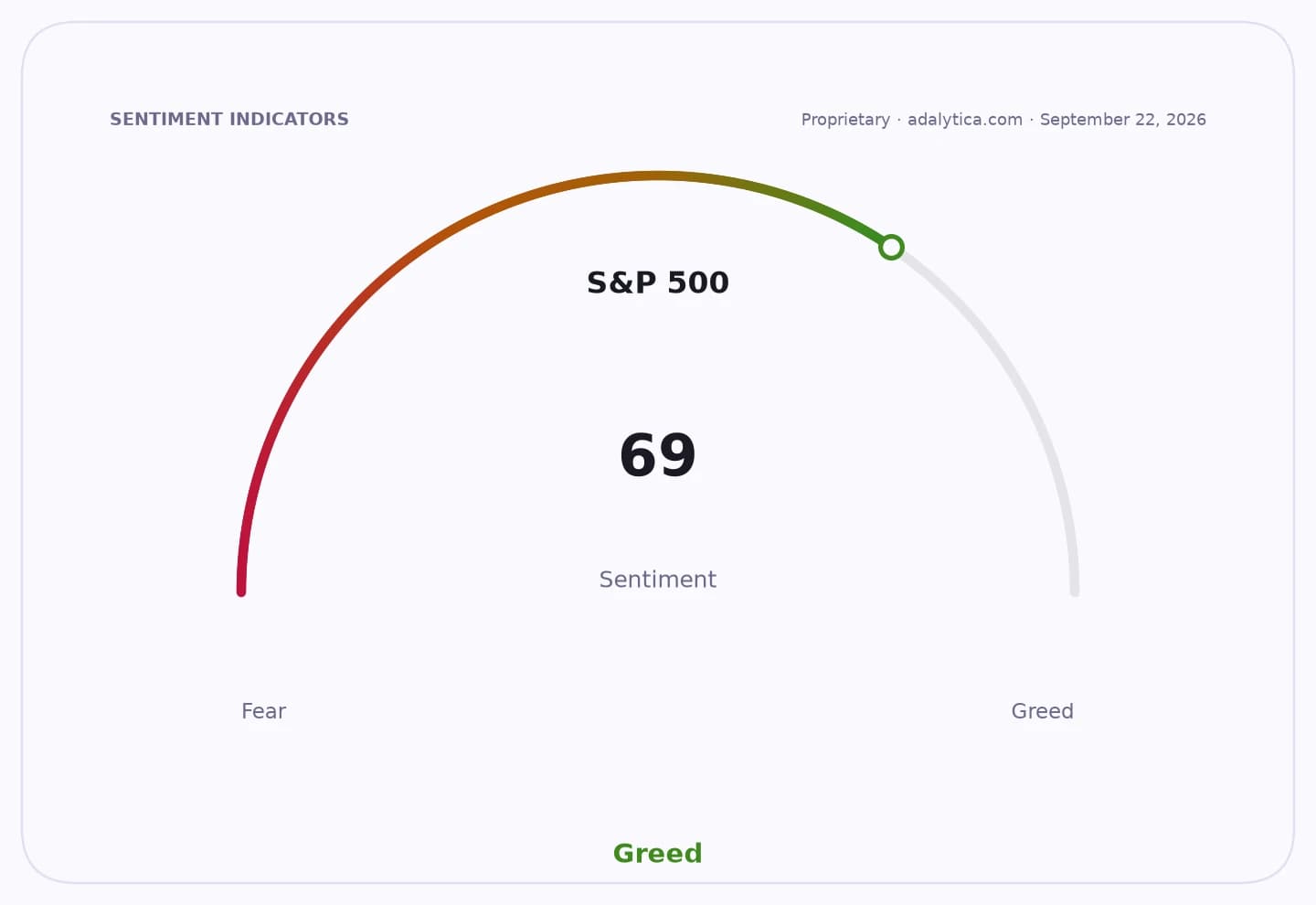
Sentiment IndicatorsⓘProprietary · adalytica.com · September 22, 2026
This is a snapshot — live sentiment, awareness and momentum for 130+ markets update continuously in the dashboard.Open AlphaPulse
The clearest market signal is in U.S. equities. SPY, a broad proxy for the S&P 500, closed at 773.38 on Sept. 22, up from 761.69 three sessions earlier, while the Nasdaq 100 ETF QQQ climbed to 747.46 from 720.70 over the same period. Both are now trading well above their 50-day and 200-day moving averages, and QQQ’s RSI has pushed to 74.8, a reading that points to an overbought market even as momentum remains firm.
The move is not happening in a vacuum. The dollar is flashing its own message, with Adalytica’s U.S. Dollar Trade Signals showing “Extreme Greed” at 98, even as its “awareness” metric points to fear. That combination usually reflects a market leaning hard into a consensus macro view: a still-resilient U.S. economy, a Federal Reserve that is not yet being priced for aggressive easing, and a demand for dollar liquidity that can persist even when equities are bid.
For Europe, the tone is more muted but still constructive. FEZ, the iShares Euro Stoxx 50 ETF, has edged up to 69.03 from 68.07 in three sessions, leaving it above its 200-day moving average but still below its 50-day average. That suggests continental equities are participating in the global risk rally, but without the same technical force seen in U.S. large-cap technology. The divergence fits a broader pattern in which European stocks remain more sensitive to growth and industrial demand, while U.S. markets continue to derive more support from earnings resilience and AI-linked enthusiasm.
The fixed-income backdrop is central to the story. The 10-year Treasury yield’s move to 4.96% and the modestly positive slope of the curve indicate a market that is no longer pricing the kind of aggressive policy tightening that hurt risk assets in 2022-23, but is also not yet convinced of a clean disinflationary glide path. That leaves equities in a narrow sweet spot: yields are high enough to keep valuations under scrutiny, yet stable enough to avoid an immediate reset in equity multiples.
There is also a cautionary message in the technical setup. SPY’s RSI at 60.4 is not stretched, but QQQ’s 74.8 and the recent approach to the upper Bollinger Band suggest a market that has run ahead of itself in parts of the growth complex. Bulls will argue that strong earnings, AI capex and continued passive inflows justify the move. Bears will counter that leadership is becoming too dependent on a small number of high-duration names, leaving the market exposed if rates stop easing or if margin expectations prove too optimistic.
For the FTSE MIB and Euro STOXX 50, the next catalyst is less about U.S. tech and more about how far sovereign yields can remain contained while growth data soften. A flatter curve and steady bond market would help European financials and cyclicals avoid a sharper de-rating. But if the 10-year yield resumes climbing, or if recession odds rise further, the current equity bid could quickly narrow into a more defensive trade.
The market’s message, for now, is that investors are willing to buy equities on the assumption that policy restraint is nearing its peak cost. What happens next will depend on whether inflation cools enough to validate that bet without confirming the weaker-growth narrative that would eventually challenge earnings.
| Entity | Gains | Losses |
|---|---|---|
| S&P 500 / SPY | ▲lower rate pressure | ▼rate-sensitive bear trades |
| Nasdaq 100 / QQQ | ▲long-duration growth stocks | ▼valuation skeptics |
| Euro STOXX 50 / FEZ | ▲risk-on spillover | ▼dollar-led U.S. outperformance |
| Treasury bears | ▲stable curve, steady yields | ▼aggressive easing bets |