North Korea fired two short-range ballistic missiles toward the sea on Sunday, intensifying military pressure on Washington just as President Donald Trump has been trying to reopen dialogue with Kim Jong Un.
North Korea fires two missiles toward the sea
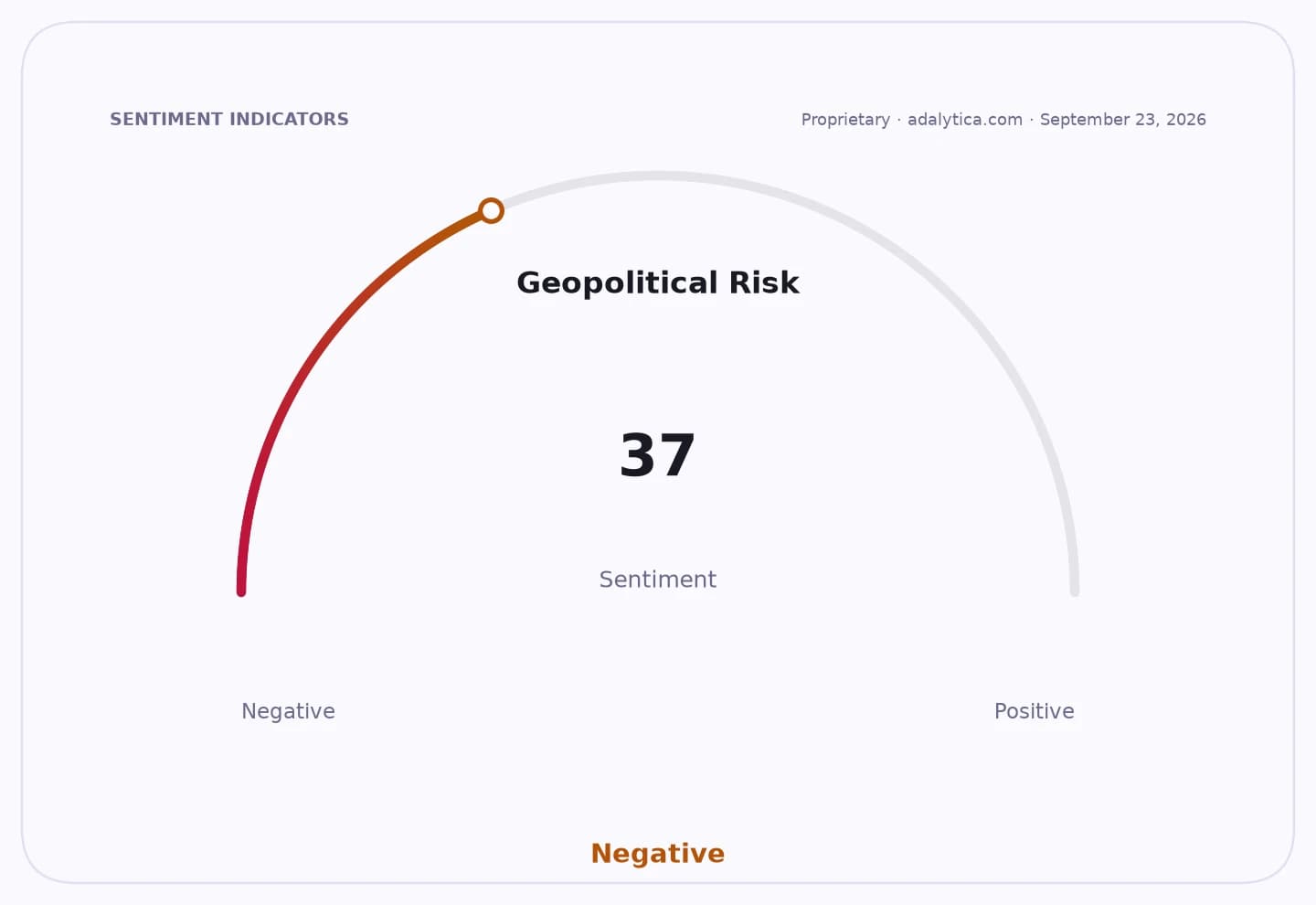
The launches matter economically because they raise the risk premium on Northeast Asia, where even limited provocations can rattle currencies, defense budgets and Korean equities. They also complicate a fragile diplomatic opening that markets had been watching for signs of lower geopolitical risk.
Sentiment IndicatorsⓘProprietary · adalytica.com · September 23, 2026
This is a snapshot — live sentiment, awareness and momentum for 130+ markets update continuously in the dashboard.Open AlphaPulse
South Korea’s military said the missiles were launched about three hours apart from the eastern coastal Wonsan area, with the first flying about 450 kilometers and the second more than 600 kilometers before landing in the North’s eastern waters. Japan’s defense ministry said it detected a suspected North Korean missile but that it did not fall in Japanese territorial waters.
Seoul urged Pyongyang to stop launches banned under U.N. Security Council resolutions, while the South Korean military said it remains ready to respond under its alliance with the United States. The episode follows a string of North Korean weapons demonstrations, including a threat from Kim Yo Jong to answer U.S.-South Korean military activity with stronger nuclear deterrence.
Geopolitical Risk — 30-day sentimentadalytica.com
Explore this data interactively — full history, time series and cross-market comparisons.Open AlphaPulse
For investors, the immediate read-through is to South Korea-sensitive assets and regional safe havens. The iShares MSCI South Korea ETF, EWY, has recently been trading around 188.34, far above its 50-day average of 173.92, while its RSI reading near 60 suggests momentum remains positive but not yet overheated. Hong Kong-listed China equities, via the FXI ETF, remain softer, and the U.S. dollar proxy UUP has been firm, reflecting continued demand for defensive positioning.
The stakes are broader than one missile test. Trump has already scaled back a joint military exercise with South Korea in an apparent bid to revive diplomacy, but North Korea has shown no sign it is ready to trade weapons development for talks. Kim’s camp has tied any return to negotiations to an end to what it calls U.S. “hostile policy” and acceptance of North Korea as a nuclear state.
That leaves markets weighing a familiar pattern: brief diplomatic gestures followed by military escalation. South Korean President Lee Jae Myung has backed a resumption of U.S.-North Korea talks, but with Pyongyang deepening its arsenal and leaning on ties with Russia and China, the path to a swift thaw remains unclear.
The next catalyst is whether the U.S. and South Korea answer with fresh drills, sanctions moves or more overt diplomacy — any of which could move regional risk assets, defense names and the Korean won.
| Entity | Gains | Losses |
|---|---|---|
| North Korea | ▲Leverage in talks | ▼Diplomatic goodwill |
| US and South Korea | ▲Deterrence posture | ▼Near-term regional calm |
| Defense contractors | ▲Higher threat demand | ▼None directly |
| EWY / Korean equities | ▲Relief on diplomacy hopes | ▼Geopolitical risk premium |