Japan’s Nikkei Stock Average continued to climb on Thursday, opening up 720.58 points at 64,643.58 as a softer yen and firmer U.S. stock futures kept global risk appetite intact. For investors, the move matters because it shows Japan’s equity rally is still being driven less by domestic fundamentals alone than by a powerful external mix of currency depreciation, Wall Street strength and heavy demand for exporters and cyclical names.
Nikkei Opens Higher on Weak Yen and U.S. Futures

The yen remained a key lever. A weaker currency boosts the overseas earnings translation of Japan’s multinationals, especially in autos, machinery, trading houses and shipping, and it helps explain why the index keeps finding buyers even after a sharp run higher. The latest trade in the currency market has reinforced that dynamic: USD/JPY rose to 155.85, a level that keeps pressure on import costs but supports corporate earnings expectations for globally exposed Japanese firms.
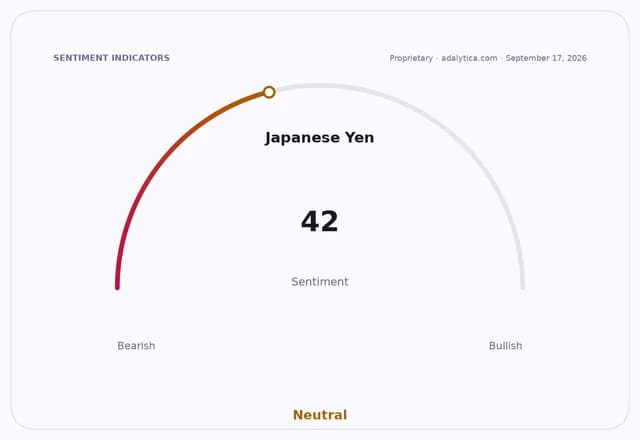
Sentiment IndicatorsⓘProprietary · adalytica.com · September 17, 2026
This is a snapshot — live sentiment, awareness and momentum for 130+ markets update continuously in the dashboard.Open AlphaPulse
That is why the Nikkei’s latest advance is not just a mood trade. It is an earnings trade. When the yen slides, the market tends to reward companies with substantial foreign revenue, and the reaction in Tokyo reflected that logic as Itochu and Nippon Yusen hit record highs, while Advantest and other semiconductor shares advanced alongside SoftBank Group. Broad participation also lifted the TOPIX, underscoring that this was not a narrow move in a handful of heavyweight names.
The U.S. backdrop helped at the margin. S&P 500 futures were firmer and the benchmark itself had already been supported by resilient semiconductor shares, giving Japanese chip-linked stocks another tailwind. That matters because Japan’s market has become increasingly tethered to the global AI and semiconductor investment cycle, where capital spending, equipment demand and supply-chain optimism can quickly spill over from the U.S. to Tokyo.
Japanese Yen vs ^N225adalytica.com
Explore this data interactively — full history, time series and cross-market comparisons.Open AlphaPulse
Technically, the Nikkei’s momentum remains constructive despite recent volatility. The index is holding well above its 50-day moving average and far above its 200-day moving average, showing the longer-term uptrend is intact even after pullbacks. The recent dip in relative strength readings had signaled cooling momentum, but Thursday’s opening surge suggests dip buyers are still eager to re-enter on currency weakness and overseas gains.
The investment implication is straightforward: the market is still underestimating how much leverage Japan’s equity complex has to the yen and to the U.S. cycle. That creates a persistent opportunity in exporters, trading houses, logistics names and semiconductor suppliers, while import-heavy sectors remain more vulnerable if the currency weakens further and policy expectations stay volatile.
The bigger question now is whether the rally can broaden beyond the familiar beneficiaries. If the yen stays soft and U.S. equities remain bid, Japanese stocks could keep outperforming on earnings revisions rather than just valuation rerating. For investors, that argues for staying positioned in the companies with the strongest foreign-exchange torque and the cleanest exposure to global capex rather than chasing the index after the move.
| Entity | Gains | Losses |
|---|---|---|
| Exporters and trading houses | ▲Stronger overseas earnings | ▼Higher import costs |
| Semiconductor stocks | ▲U.S. tech momentum | ▼Policy-driven risk-off swings |
| Japanese equities | ▲Broad index support | ▼Yen-strength unwind |
| Import-reliant sectors | ▲None | ▼Margin pressure from weak yen |