Banks of the future will be more digital, more automated and still very much staffed by people, according to Mastercard, as the payments giant argues the real shift is not a wholesale replacement of the banking system but a broadening of how money moves.
Mastercard on AI, stablecoins and banking rails

That matters because the next wave of financial innovation is increasingly about infrastructure, not just apps. If banks, card networks and digital-asset platforms can make AI, stablecoins, tokenized deposits and digital currencies work together safely, the result could be faster payments, cheaper cross-border transfers and lower fraud costs across the global financial system.
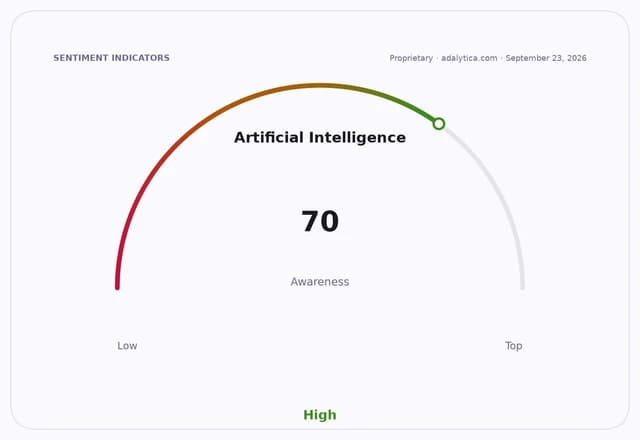
Sentiment IndicatorsⓘProprietary · adalytica.com · September 23, 2026
This is a snapshot — live sentiment, awareness and momentum for 130+ markets update continuously in the dashboard.Open AlphaPulse
Cosmin Vladimirescu, Mastercard’s general manager for Romania and Croatia, said artificial intelligence will first take over repetitive tasks, while people will remain essential in customer relationships, risk management and new product development. That is the more important point for investors: AI in banking is likely to boost productivity and margins before it destroys jobs, especially in areas where trust and judgment still matter.
The broader message is that the payments stack is becoming plural, not singular. Mastercard sees a future where cards, bank accounts, stablecoins, tokenized deposits and other forms of digital money coexist in the same ecosystem. The company’s view tracks a wider shift in Europe, where the European Central Bank has already launched a blockchain-based payment service and signaled plans to invest in digital securities infrastructure.
For investors, that keeps the long-term case for payment networks, major banks and crypto infrastructure names intact, but it also raises the bar. The winners will be the companies that can connect multiple payment rails, not those betting on one format to dominate. Mastercard’s argument is that interoperability, security and scale will matter more than ideology in the next phase of finance.
Security remains the biggest constraint and the biggest opportunity. As digital payment methods multiply, banks will have to spend more on fraud prevention, data protection and transaction integrity, areas where AI and even quantum-related tools could become competitive advantages. Mastercard is effectively saying the future of banking will not be cash versus cards versus crypto, but a layered system where trusted intermediaries make all of it usable.
For long-term investors, that is a constructive backdrop for the payments industry and for financial technology more broadly. The risk is execution: regulation, cybersecurity and customer adoption will decide which platforms turn this transition into durable earnings growth. Still, the direction of travel is clear, and companies that help make the system safer and easier to use deserve a place on the watchlist.
| Entity | Gains | Losses |
|---|---|---|
| Mastercard, Visa | ▲More payment rails to connect | ▼Simple one-network models |
| Banks | ▲AI efficiency and new digital products | ▼Manual back-office workflows |
| Stablecoins, tokenized deposits | ▲Broader real-world use | ▼Purely speculative crypto tokens |
| Cash-only and siloed systems | ▲Nothing | ▼Interoperability and lower-cost digital payments |