When productivity gets stuck at one stage of production, the biggest gain often comes not from buying more machines but from finding the exact point where work stops flowing. That message is increasingly central for manufacturers and defense suppliers trying to turn technology spending into real output gains.
Manufacturers focus on bottlenecks and OEE gains

The economic stakes are broad. Bottlenecks raise unit costs, slow deliveries, increase work-in-progress inventory and weaken margins, which matters for industrial firms, logistics providers and suppliers alike. In a soft growth environment, even small improvements in uptime, changeover time or defect rates can lift effective capacity without the capital burden of a new plant.
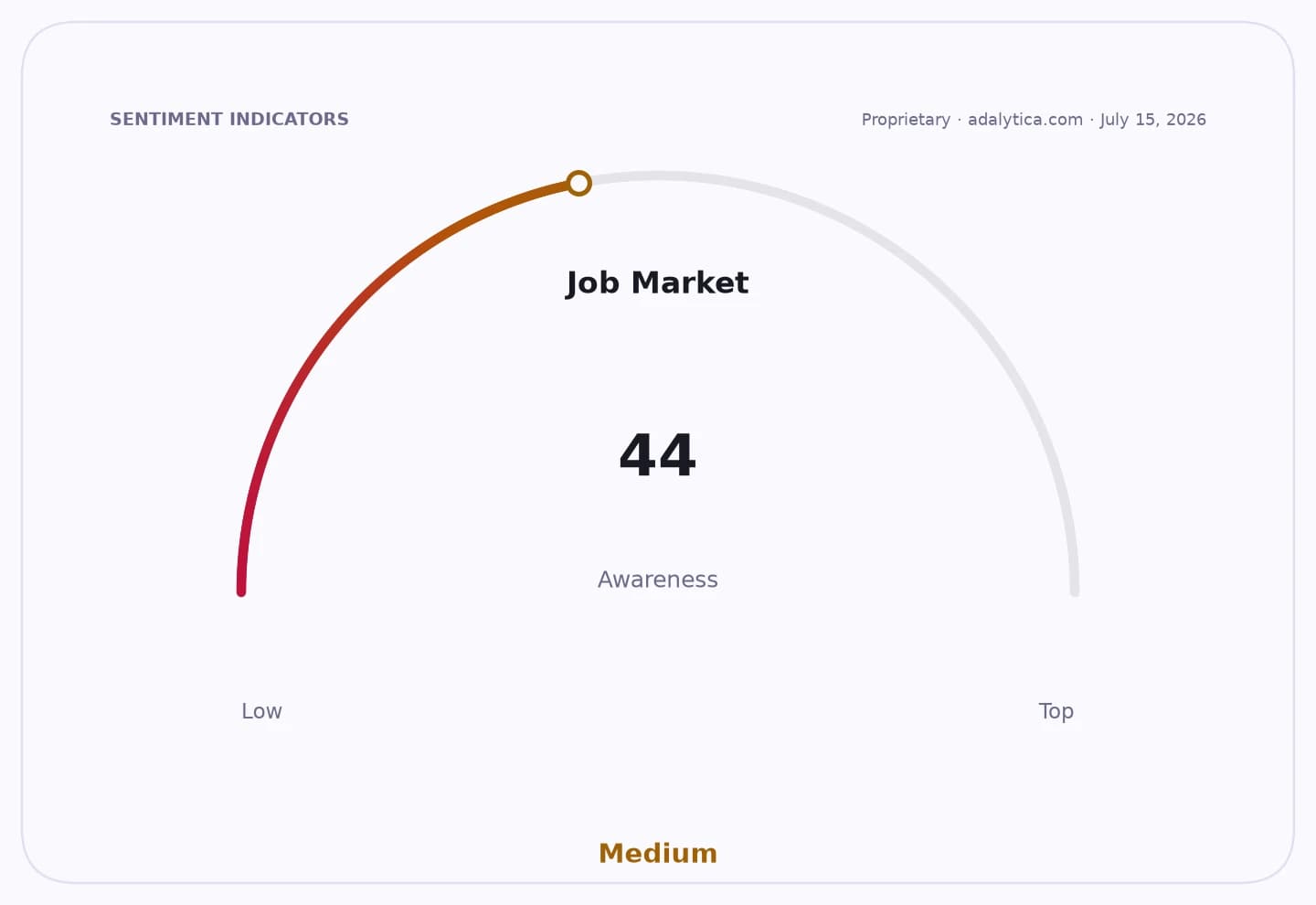
The point is showing up in industrial data and corporate disclosures. U.S. industrial production has risen to 103.0682 in August, above 99.2223 in January 2024, while job openings remain elevated at 7,271,000 in July, suggesting labor demand is still tight even as companies struggle to match headcount, equipment and materials with demand. The unemployment rate held at 4.1% in August, underscoring that the constraint is less about labor availability than about how efficiently businesses deploy it.
That is why manufacturers are increasingly focusing on overall equipment effectiveness, or OEE, and other lean metrics that separate real capacity from headline throughput. OEE breaks performance into equipment availability, operating speed and quality, helping firms identify losses from stoppages, slowdowns and rework rather than simply measuring end-of-line output.
INDPRO vs JTSJOL — macro contextadalytica.com
Explore this data interactively — full history, time series and cross-market comparisons.Open AlphaPulse
The market relevance is clearest in capital-heavy industries such as aerospace, defense and machinery, where scaling production requires converting innovation into repeatable industrial processes. Honeywell’s filings warn that integrating third-party artificial intelligence models carries execution and safeguards risk, a reminder that digital tools can help optimize workflows only if the underlying process is disciplined enough to absorb them. Deere, meanwhile, says production efficiencies have improved with higher manufacturing volumes, but it still flags demand forecasting, inventory management and operating cash flow as active constraints.
Investors care because this is where margin expansion lives. A company that solves for waiting time, idle equipment or excessive rework can often grow output faster than revenue grows costs, which supports earnings quality and cash flow. The reverse is also true: a faster line that creates more defects or inventory can destroy returns even when factory utilization looks better.
That is why lean manufacturing, Kaizen and total productive maintenance are gaining emphasis over one-off expansion projects. These approaches push firms to measure downtime, waiting, setup time, transport and scrap, then test fixes on one process before rolling them out. In defense and industrial supply chains, the same logic is encouraging mergers and acquisitions as companies try to scale faster, transfer technology into production and reduce the distance between invention and manufacturing.
The next test is whether companies can keep moving the bottleneck rather than merely shifting it. As one stage improves, the constraint often migrates elsewhere, which means productivity gains only stick when managers keep tracking the full line, not a single output target. For investors, that makes execution on process discipline, automation and AI adoption a better near-term indicator than capacity announcements alone.
| Entity | Gains | Losses |
|---|---|---|
| Manufacturers | ▲Higher output per asset | ▼Idle time and rework |
| Investors | ▲Better margins and cash flow | ▼Capex-heavy inefficiency |
| Defense suppliers | ▲Faster tech-to-production scaling | ▼Fragmented operations |
| Logistics workers | ▲Smoother workflows | ▼Waiting and bottlenecks |