JPMorgan Chase’s move to elevate two longtime dealmakers into broader leadership comes as investors are still pricing the bank as the industry’s best-run franchise, leaving its new turnaround team to prove it can sustain growth without overextending returns or capital.
JPMorgan names Petno and Rohrbaugh to top roles
The appointment of Doug Petno and Troy Rohrbaugh to co-president roles, with Petno also becoming sole chief executive of the Commercial & Investment Bank, is the clearest sign yet that JPMorgan wants deeper succession planning and tighter operating control at the core of its most cyclical businesses. That matters because the commercial and investment bank remains the engine that can most quickly amplify gains — or expose the firm to a slowdown in underwriting, trading and advisory fees.
Sentiment IndicatorsⓘProprietary · adalytica.com · September 16, 2026
This is a snapshot — live sentiment, awareness and momentum for 130+ markets update continuously in the dashboard.Open AlphaPulse
The challenge is not a distressed balance sheet. It is preserving a premium valuation. JPMorgan shares closed at $352.49 on Sept. 15, well above both the 200-day moving average of $318.05 and the 50-day average of $352.35, after a run that has pushed the stock close to the upper end of its recent Bollinger Band range. The latest reading on the 50-day average suggests momentum has cooled after a strong rally, but the longer trend remains intact. For a bank that already trades as the sector’s benchmark, the market is demanding execution, not just continuity.
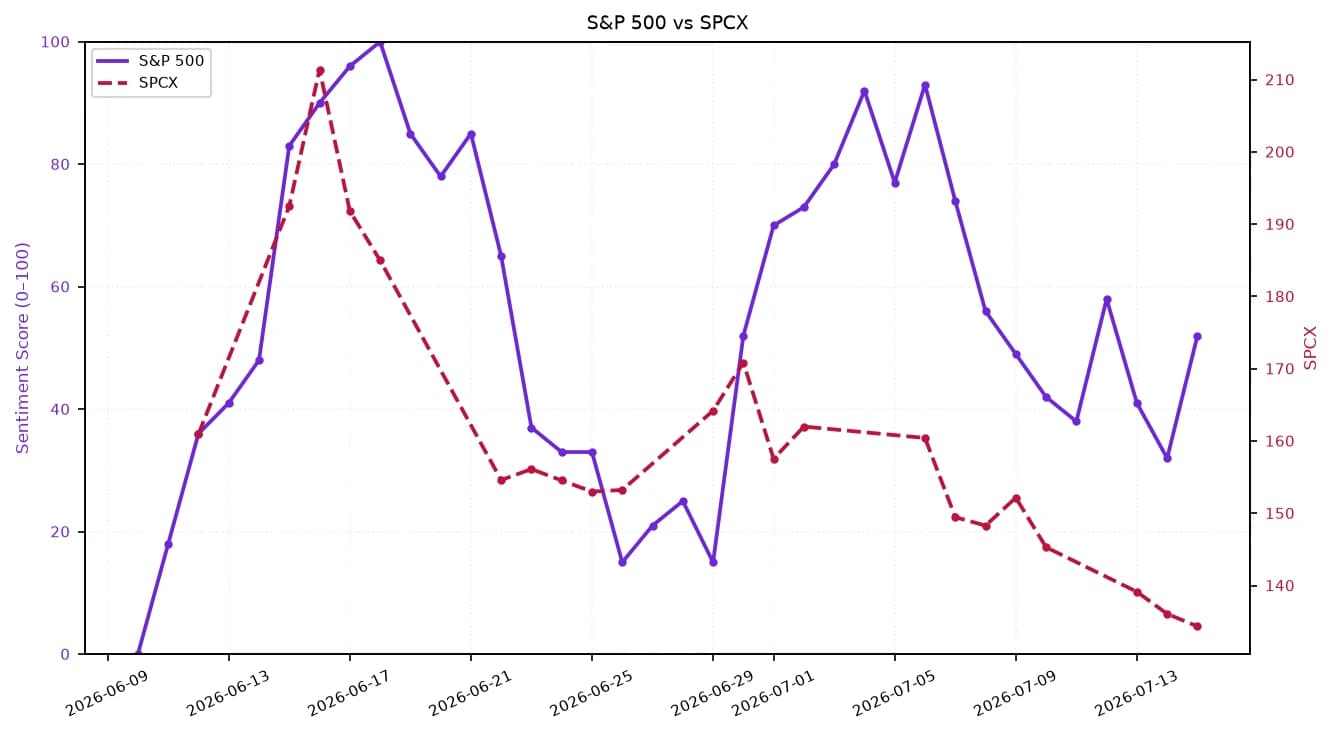
That puts the new leadership arrangement under scrutiny at a time when the broader market is cautious. Adalytica’s S&P 500 trade signals show “Extreme Fear,” while the dollar has strengthened sharply over the past month, a combination that typically tightens financial conditions and can weigh on deal activity. For JPMorgan, that means the test is whether the firm can keep fee income resilient and credit costs contained if capital markets soften further.
The stock’s technical profile reflects that tension. JPMorgan’s RSI reading has slipped to 44.4 from overbought territory above 80 earlier this summer, while MACD has rolled lower, suggesting the pace of the rally has slowed even as the shares remain far above their longer-term averages. Investors often read that as a pause rather than a reversal, but for a lender already near record territory, any sign of weaker earnings momentum could trigger multiple compression.
The broader implication is that JPMorgan’s turnaround job is less about fixing a broken institution than about managing a very successful one through a more difficult cycle. Petno and Rohrbaugh inherit a firm with unmatched scale in consumer banking, markets and payments, but also one that has to keep demonstrating that size still translates into superior returns.
For investors, the key question is whether the new structure can protect JPMorgan’s premium in a market that is becoming less forgiving. If capital markets recover and credit stays benign, the bank can justify the leadership changes as succession discipline. If volatility, regulation or a slowdown in fees bites harder, the same structure will be judged as an early response to a more demanding operating environment.
| Entity | Gains | Losses |
|---|---|---|
| JPMorgan management | ▲Clearer succession plan | ▼Higher execution scrutiny |
| JPMorgan shareholders | ▲Continued premium franchise | ▼Multiple compression risk |
| Investment-banking rivals | ▲Little immediate gain | ▼JPMorgan keeps scale edge |
| Equity investors | ▲Stable earnings visibility | ▼Slower upside if cycle weakens |