The Trump administration has moved India closer to the risk of a 100% U.S. tariff after the president signed a Russia and Iran sanctions law that expands his authority to hit countries buying Russian oil and gas, even as he signaled warmer ties with China.
India Faces U.S. Tariff Risk Over Russian Oil
The law does not automatically impose the tariff, but it gives Trump 30 days to act against countries among the top five buyers of Russian hydrocarbons, putting India and China in the crosshairs. For the world’s fifth-largest economy, that raises the stakes around exports to the U.S., energy procurement and already fragile trade talks.
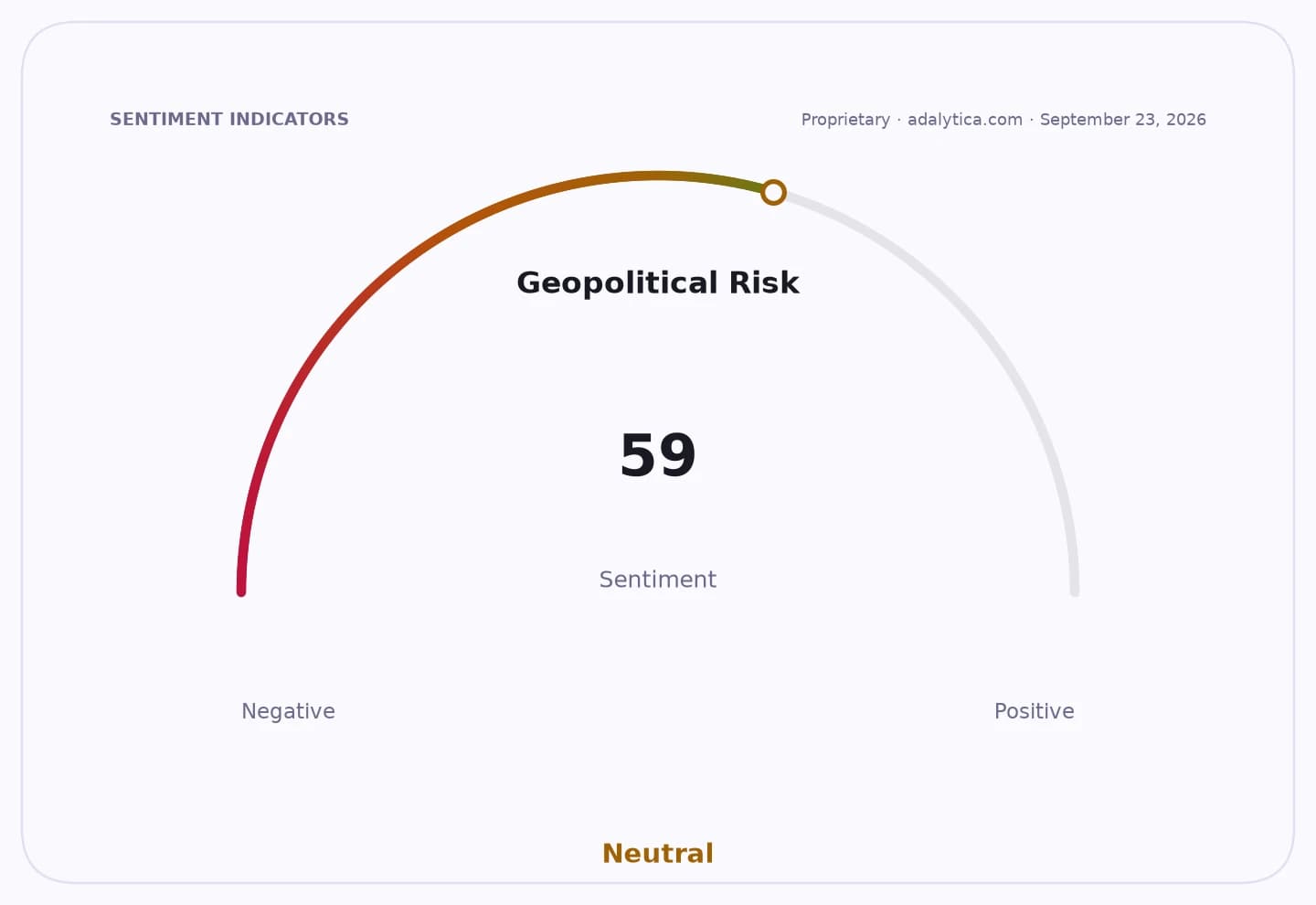
Sentiment IndicatorsⓘProprietary · adalytica.com · September 23, 2026
This is a snapshot — live sentiment, awareness and momentum for 130+ markets update continuously in the dashboard.Open AlphaPulse
India responded by drawing a line around its foreign policy. Junior foreign minister Kirti Vardhan Singh said New Delhi will buy energy wherever it gets the best economic deal, underscoring that it will not let Washington dictate sourcing decisions.
The economic risk is immediate. India has emerged as one of the biggest buyers of discounted Russian crude since the war in Ukraine, and a steep tariff would hit labor-intensive exports such as textiles, leather, chemicals and machinery that rely on access to the U.S. market. A 100% levy would effectively price many Indian goods out of America, potentially slicing into growth, current-account dynamics and corporate earnings.
The move also comes with a second pressure point: Trump extended for another year a $100,000 fee on H-1B visas, a step that adds to the strain on India’s technology sector and its large pool of workers in the U.S. According to U.S. citizenship data, Indian-born beneficiaries accounted for about 71% of approved H-1B petitions in 2024, making the policy especially relevant for Indian IT services firms and American tech employers.
Markets are already sensitive to the broader trade backdrop. India-focused ETF EPI has slipped to $42.07 from $46.21 in February, while the iShares China Large-Cap ETF FXI remains below its 200-day moving average, reflecting investors’ caution toward Asia trade exposure. The U.S.-China relations gauge from Adalytica.com showed extreme greed and a sharp one-day jump in sentiment, while the dollar signal stayed at extreme greed, suggesting investors are still leaning toward a stronger greenback in a tariff-heavy environment.
Trump’s friendlier tone toward Beijing complicates the picture for India. He said relations with Chinese President Xi Jinping are “very good” and that Xi will visit next week, a sign that Washington may be willing to bargain with Beijing even as it tightens pressure on New Delhi over Russian energy.
For investors, the message is that India’s export outlook is now tied not just to domestic demand and earnings, but to the pace and scope of any U.S. tariff action. The next catalyst is Trump’s decision within the 30-day window, which could determine whether the threat stays as leverage or becomes a direct hit to Indian trade, technology and currency markets.
| Entity | Gains | Losses |
|---|---|---|
| U.S. hardliners | ▲More leverage on Russia-linked buyers | ▼Higher trade friction |
| India exporters | ▲Limited near-term upside from policy clarity | ▼U.S. market access risk |
| Chinese exporters | ▲Relative tariff relief if ties stay warm | ▼Still exposed to U.S. bargaining |
| Indian IT firms / H-1B workers | ▲None | ▼Higher visa costs, hiring pressure |