India is turning its cow-dung-to-gas experiment into a state-backed market, a move that could finally make compressed biogas investable at scale.
India Gobardhan scheme backs compressed biogas market
The government has approved a 23,731 crore rupee Gobardhan scheme that promises to buy up to 100% of salable compressed biogas from eligible producers for at least 10 years, while also offering administered pricing, capital support and other incentives. For investors, the significance is simple: India is not just promoting a cleaner fuel, it is creating guaranteed demand for a sector that has long struggled with feedstock collection, offtake uncertainty and weak project economics.
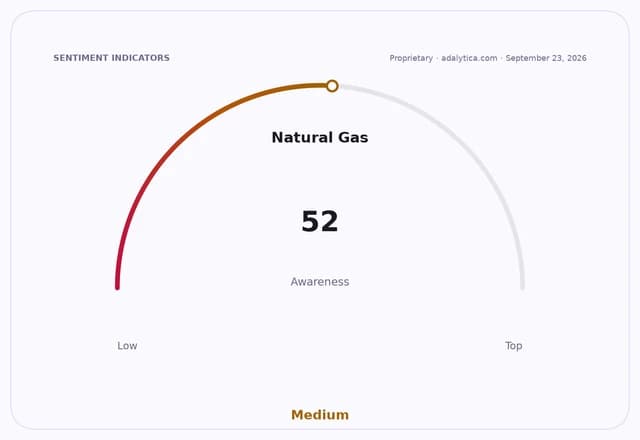
Sentiment IndicatorsⓘProprietary · adalytica.com · September 23, 2026
This is a snapshot — live sentiment, awareness and momentum for 130+ markets update continuously in the dashboard.Open AlphaPulse
That matters economically because compressed biogas, or CBG, can help India trim imported fuel use while monetizing agricultural residue, cattle dung and food waste that would otherwise be underused or burned. The policy also ties into a broader push for energy security and waste management, both of which carry real fiscal and environmental costs. By requiring city gas distributors to source a rising share of CBG in their compressed natural gas and piped natural gas supply — 3% in fiscal 2026-27, 4% in 2027-28 and 5% from 2028-29 — New Delhi is effectively forcing the market to grow.
The pricing floor is what makes this more than a feel-good rural policy. The government has set an administered price of 2,110 rupees per MMBtu, equivalent to about 98 rupees per kg based on 95% methane content, excluding taxes and compression charges. That price, guaranteed through March 31, 2036, gives developers and lenders something they can underwrite. In a capital-intensive business, long-term revenue visibility is often the difference between a pilot project and a financeable platform.
For investors, the winners are likely to be CBG developers, equipment makers, feedstock aggregators and gas distributors that can build compliant supply chains. The scheme also has a clear long-term appeal for companies tied to renewables, biofuels and gas infrastructure, including global energy names with exposure to cleaner fuels and distribution networks. The losers are more likely to be conventional gas suppliers and distributors that must absorb mandatory blending costs, at least in the near term.
This is also a reminder that India’s energy transition may look less like a clean break and more like a layering of fuels. Natural gas is still central to the country’s industrial and urban energy mix, but Gobardhan creates a bridge from agricultural waste to the gas grid. That makes the policy attractive politically and economically: it supports farmers, reduces landfill pressure, and creates another domestic fuel source without waiting for a wholesale overhaul of the energy system.
The key question now is execution. The government can write the rules, but the industry still has to solve collection logistics, plant utilization, quality control and pipeline access. If those problems are managed, the scheme could build a durable CBG market over the next decade. For long-term investors, it is worth watching closely — not because it will move earnings next quarter, but because it could shape an entirely new energy supply chain in India.
| Entity | Gains | Losses |
|---|---|---|
| CBG producers | ▲10-year revenue visibility | ▼Offtake uncertainty |
| Gas distributors | ▲Supply from domestic blend | ▼Higher compliance costs |
| Farmers and waste collectors | ▲New monetization channel | ▼Less for informal handlers |
| Fossil gas suppliers | ▲— | ▼More competition from CBG |