France risks compounding a long productivity slowdown unless it accelerates the adoption of generative artificial intelligence across its companies, according to a government-linked report that argues the country has already paid a steep economic price for past delays in digital uptake.
France AI Adoption Report Warns on Productivity Gap
The report from the Conseil d’analyse économique, an advisory body attached to the prime minister’s office, says weaker productivity has explained the entire gap in GDP per capita growth between France and the US since 1995. Productivity has risen only 0.8% a year in France over the past three decades, compared with 1.1% in the euro area and 1.7% in the US, the report said.
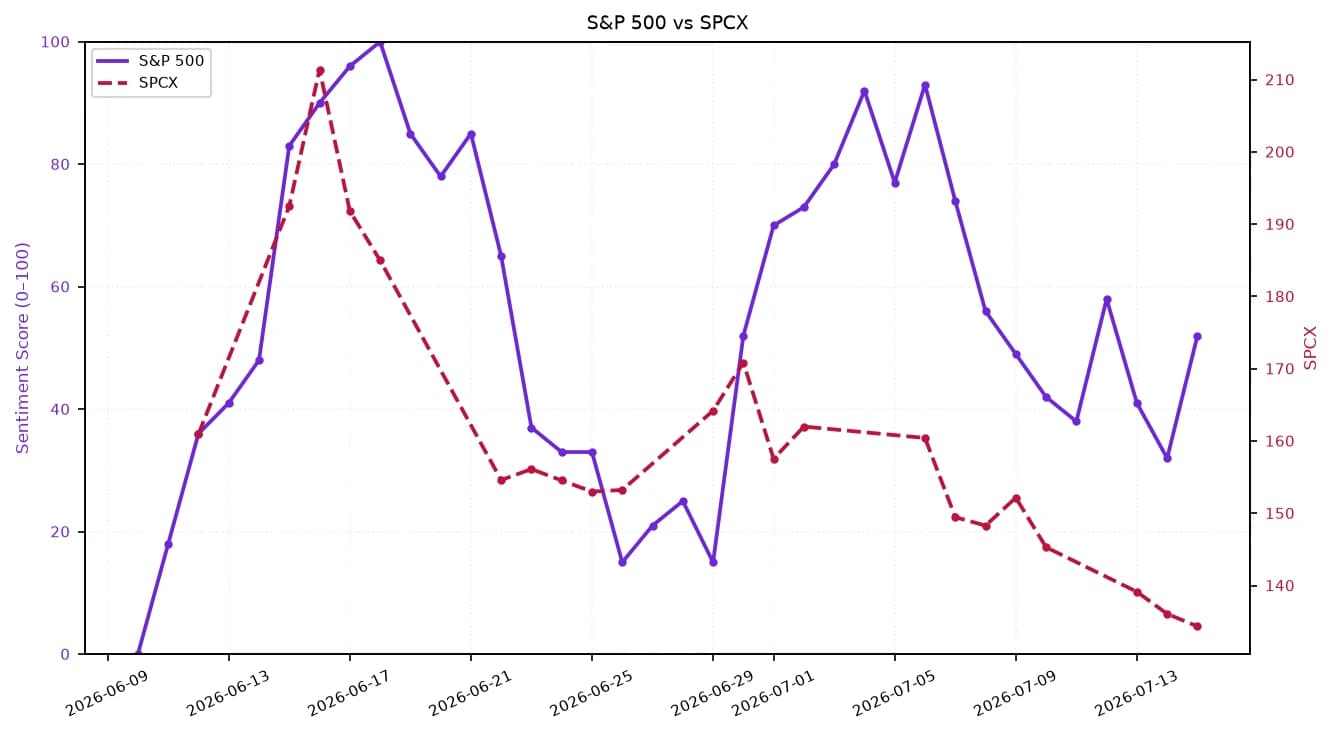
Sentiment IndicatorsⓘProprietary · adalytica.com · September 19, 2026
This is a snapshot — live sentiment, awareness and momentum for 130+ markets update continuously in the dashboard.Open AlphaPulse
That matters because productivity is the main engine of wages, corporate margins and tax receipts. Xavier Jaravel, the body’s deputy chair, said France should not “miss the train” of generative AI adoption as it did with some of the digital economy. He estimated that absent the productivity gap, the French state would be collecting as much as 400 billion euros more in annual revenue.
The warning lands at a time when Europe is trying to close a widening gap with the US in AI investment, cloud infrastructure and enterprise software adoption. For investors, the message is that the biggest near-term payoff from AI may not come only from frontier model developers, but from the companies that can turn the technology into measurable efficiency gains across finance, retail and other labour-intensive sectors.
The CAE is urging Paris to back “ambitious public policies” to spread innovation, especially generative AI, and to do so even in a tighter fiscal environment. It wants a new France 2040 programme to commit at least 0.2 percentage points of GDP a year to innovation support, arguing that France 2030, President Emmanuel Macron’s existing investment plan, effectively pays for itself over time through higher corporate tax and other receipts from winning firms.
That is a notable endorsement of industrial policy at a moment when Europe is debating how to fund competitiveness without worsening public finances. The report also takes a sharper line on the research tax credit, saying it is far from self-financing and should be more tightly targeted because some incentives amount to windfalls for large groups.
For markets, the policy debate is part of a broader AI capital cycle already visible in US megacap earnings and spending. Microsoft, Alphabet and Nvidia remain central beneficiaries of the build-out in cloud and AI infrastructure, but the French report underscores a second-order theme: economies that fail to diffuse the technology broadly may see slower growth even as the AI leaders capture the upside.
The investment case for AI in Europe therefore hinges less on headline enthusiasm than on execution. If France can move faster on adoption, productivity could improve, wage growth could broaden and fiscal pressure could ease. If not, the country risks staying trapped in a low-growth, low-revenue pattern while the US and a handful of large tech groups keep taking the economic gains.
| Entity | Gains | Losses |
|---|---|---|
| French firms adopting AI | ▲Higher productivity, lower costs | ▼Legacy processes, slow adopters |
| French state | ▲Higher tax receipts, stronger growth | ▼Fiscal strain, lost revenue |
| AI vendors and cloud providers | ▲More enterprise demand | ▼Firms delaying rollout |
| Large incumbents using tax credits | ▲Innovation support | ▼Tighter targeting of subsidies |