Ethereum’s path to $6,000 by the end of 2026 is being driven less by retail speculation than by a powerful mix of tokenization, institutional adoption and rising on-chain activity that could make ETH one of the market’s most asymmetric trades.
Ethereum Path to $6,000 on Tokenization and Adoption
That is the core of Tom Lee’s latest call, and it matters because Ethereum is no longer just a cyclical crypto bet. If the network keeps winning share in tokenized assets and institutional use cases while Bitcoin continues toward the kind of move Lee envisions, ETH has room to outperform on both fundamentals and relative value.
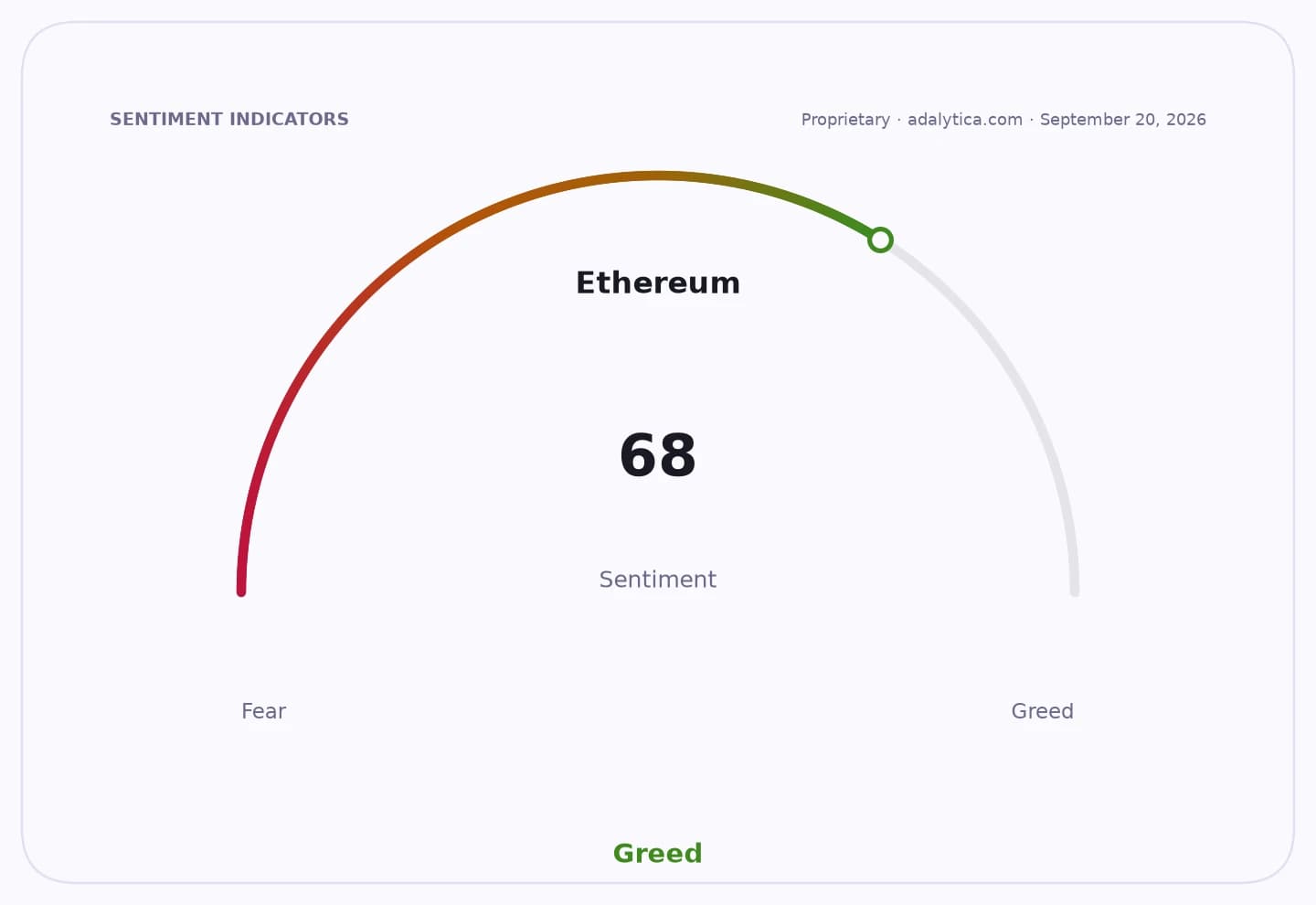
Sentiment IndicatorsⓘProprietary · adalytica.com · September 20, 2026
This is a snapshot — live sentiment, awareness and momentum for 130+ markets update continuously in the dashboard.Open AlphaPulse
The setup is already visible in the market. Ether is trading around $2,600, after a three-session advance back above $2,500, with short-term resistance seen in the $2,600 to $2,670 zone and support around $2,400. On conventional technical indicators, ETH’s 50-day moving average sits above its 200-day moving average, while RSI readings have cooled from overbought levels near 92 in August to the mid-50s, suggesting the market has reset without breaking the broader trend.
What makes the bull case compelling is that Lee is not relying on a one-off price squeeze. His thesis links Ether’s upside to a larger capital rotation: Bitcoin moving toward $150,000, institutions chasing the best-performing asset into year-end, and Ethereum strengthening versus Bitcoin as adoption deepens. In other words, ETH does not need a perfect market to work — it needs a favorable risk-on cycle and continued proof that the network remains the default settlement layer for tokenization and decentralized finance.
That is where the real economic significance lies. Tokenization turns blockchains into infrastructure for financial markets, and Ethereum remains the most important public-chain beneficiary if that theme scales. Every new asset class that migrates on-chain — from funds to real-world assets to institutional settlement flows — creates more demand for block space, more fee generation and more reasons for large players to treat ETH as productive infrastructure rather than a speculative token.
Investors should also notice the macro backdrop. Lower rates and a friendlier liquidity environment tend to support long-duration risk assets, and crypto has historically responded quickly when capital starts reaching for higher-beta winners. Adalytica’s Ethereum awareness reading is at 88, labeled extreme greed, while sentiment sits at a more restrained 68, a combination that suggests high visibility but not yet a fully euphoric blow-off. Bitcoin’s own sentiment reading is also in greed territory, which supports the broader crypto bid.
The market is still underestimating the second-order winners from that setup. If Ethereum sustains institutional traction, the beneficiaries are not limited to ETH holders. Coinbase stands to gain from higher trading volumes and custody demand, while crypto miners and infrastructure names tied to the broader digital-asset complex can also benefit from renewed market activity. By contrast, any stall in tokenization or a sharper pullback in Bitcoin would hit the entire complex, especially the names most dependent on rising volumes and speculative turnover.
The key question now is whether Ethereum can hold above the $2,400 support area and build a base for another push toward the $2,600s and beyond. If it can, Lee’s $6,000 target stops looking like a stretch and starts looking like the kind of forecast that becomes conservative in a real institutional chase. For investors, the opportunity is to position ahead of that inflection point, not after the market has already repriced the story.
| Entity | Gains | Losses |
|---|---|---|
| Ethereum holders | ▲Price upside from adoption | ▼Missed rally if sidelined |
| Bitcoin maximalists | ▲Broader crypto validation | ▼ETH relative outperformance |
| Coinbase (COIN) | ▲Higher trading and custody activity | ▼Volume slump if crypto cools |
| Ether bears | ▲Lower conviction trade setup fails | ▼Short squeeze risk |