BRICS leaders used the New Delhi summit to turn the bloc from a loose economic forum into a broader platform for Global South representation, a shift that matters for trade, development finance and the geopolitical weight of emerging markets.
BRICS New Delhi Summit Broadens Agenda

The declaration’s most important economic implication is that it widens BRICS’ agenda beyond statements on trade to practical coordination on cross-border payments, local currencies, digital public infrastructure, technology transfer and development funding. For investors, that raises the odds of more intra-bloc financial plumbing that could eventually lower transaction costs for emerging-market trade and reduce reliance on dollar-denominated settlement in some bilateral flows.
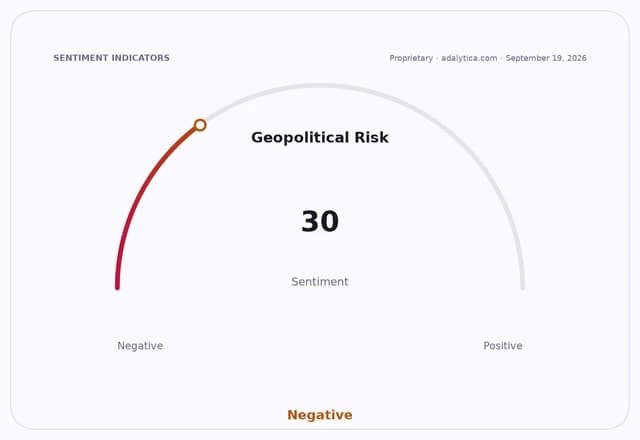
Sentiment IndicatorsⓘProprietary · adalytica.com · September 19, 2026
This is a snapshot — live sentiment, awareness and momentum for 130+ markets update continuously in the dashboard.Open AlphaPulse
India came out of the summit with a clear diplomatic win. The declaration endorsed a more representative global order, backed reform of multilateral institutions and explicitly recognized African aspirations, including references to the Ezulwini Consensus and the Sirte Declaration, giving New Delhi a stronger case for positioning itself as a bridge between Africa and the wider emerging world.
That has direct economic relevance for India and African economies. The text moves the relationship away from simple goods trade toward manufacturing, value chains, technical cooperation and skill transfer, while also elevating digital identity, payments infrastructure, AI, fintech and health collaboration as future growth areas. For Africa, the appeal is obvious: cheaper payments, broader access to digital systems and more support for local production capacity.
The market angle is less immediate but still important. BRICS’ push for local-currency settlements and a more resilient financial architecture feeds a longer-running debate about the dollar’s role in emerging-market trade. The greenback remains dominant, but any credible move by large developing economies to cut payment frictions and hedge external financing shocks would matter for banks, payment networks, commodity traders and investors with exposure to frontier trade corridors.
BRICS also signaled that Africa is now more central to its institutional agenda, not just its trade ambitions. The declaration welcomed more ICAO Council seats for under-represented regions and Ethiopia’s candidature, reinforcing the idea that the bloc wants influence in multilateral bodies, not just parallel development projects.
The backdrop helps explain why the message landed. Adalytica’s Global Stability Sentiment gauge sits in “Fear” at 30, while its US Dollar Trade Signals show “Extreme Greed” at 91, underscoring a market still leaning toward dollar strength even as BRICS talks up alternatives. That gap suggests investors are treating BRICS’ ambitions as a medium-term structural theme rather than an immediate threat to the financial system.
For now, the key test is implementation. If the summit’s promises on development finance, payments, digital infrastructure, health and manufacturing turn into project-level commitments, BRICS could become more than a geopolitical symbol and start shaping trade, capital flows and policy alignment across the Global South.
| Entity | Gains | Losses |
|---|---|---|
| India | ▲Diplomatic leadership | ▼Reliance on Western-led forums |
| Africa | ▲Greater representation | ▼Limited leverage in global institutions |
| BRICS bloc | ▲Broader institutional relevance | ▼Narrow commodity-and-trade identity |
| US dollar system | ▲Continued dominance for now | ▼Pressure from local-currency settlement efforts |