Bangladesh’s economy has expanded rapidly over the past decade, but the pace of job creation has weakened sharply, exposing a structural fault line that could limit the next phase of growth.
Bangladesh job growth weakens as GDP keeps rising

A World Bank policy paper says the link between output and employment in Bangladesh has become much weaker, even as real GDP grew an average 6.4% a year from 2010 to 2023. That matters because the country’s development model has long depended on labor-intensive industry, especially garments, to turn growth into wages, spending power and poverty reduction. If growth is no longer reliably producing formal jobs, the economy risks becoming more productive on paper without generating enough secure work for its workforce.
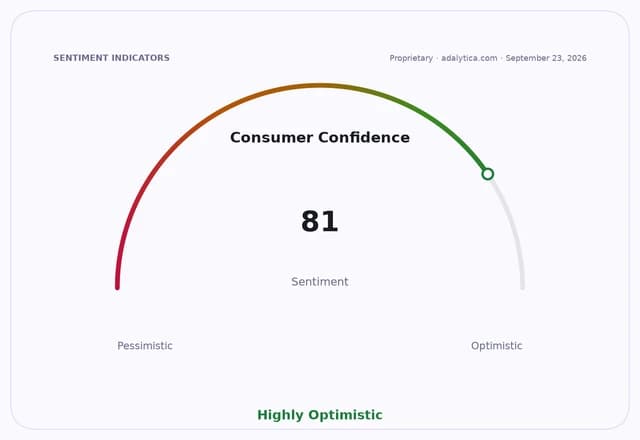
Sentiment IndicatorsⓘProprietary · adalytica.com · September 23, 2026
This is a snapshot — live sentiment, awareness and momentum for 130+ markets update continuously in the dashboard.Open AlphaPulse

The study found that between 2017 and 2022, industry grew about 9% a year and services 5.9%, yet both sectors lost share of total employment. Manufacturing, despite annual growth of roughly 9.1%, saw its employment share fall to 11.3% from 14.4%. The paper also said Bangladesh has one of the weaker growth-employment links among a group of Asian peers, including Indonesia, suggesting the problem is not just cyclical but structural.
That has direct consequences for incomes, consumption and political stability. Roughly 84.9% of jobs are informal, so the issue is not simply whether people are employed, but whether those jobs are productive, secure and capable of supporting household demand. A labor market dominated by low-quality work tends to restrain productivity growth, weaken tax collection and leave the economy more exposed when external demand slows.
The shift is especially visible in industry. Employment elasticity in the sector fell from 0.84 in 2003-2010 to minus 0.04 in 2017-2024, meaning industrial growth is now creating little to no additional employment. Services remain a source of jobs, but their elasticity also eased to about 0.23. Agriculture, meanwhile, is absorbing more workers, which the paper warns may reflect a fallback into lower-productivity activity rather than a healthy structural transition.
For investors, the message is that Bangladesh’s growth story is less straightforward than headline GDP implies. Domestic demand may still benefit from rising output, but the lack of broad-based job creation can curb consumption growth over time and complicate policy efforts to deepen the formal economy. It also raises questions for manufacturers and exporters relying on a large labor pool, particularly if productivity gains are not matched by new hiring.
The paper points to sectors such as accommodation and food services, transportation, construction and tourism-related activity as potential job engines, while also highlighting the need for better training and skills alignment. That supports the government’s emphasis on technical and technology education, but the challenge is bigger than reskilling alone: Bangladesh will need growth that is more labor-absorbing, more formal and less dependent on fallback employment in agriculture.
For now, the economic narrative has shifted from how fast Bangladesh can grow to how effectively it can turn growth into jobs. That will be the key test for the country’s next stage of development.
| Entity | Gains | Losses |
|---|---|---|
| Workers in formal sectors | ▲Better skills demand | ▼Slower job absorption |
| Agriculture | ▲More labor supply | ▼Lower productivity pressure |
| Manufacturers | ▲Output growth focus | ▼Employment intensity |
| Policymakers | ▲Reform momentum | ▼Growth-quality credibility |