AI is starting to change the structure of work faster than it is changing the level of employment, with companies using the technology to redesign tasks, supervision and hiring pipelines even as the data on job losses remains inconclusive.
AI Is Rewiring Work, Not Just Cutting Jobs
That is the central finding from new research highlighted at a London School of Economics seminar on AI and the future of work, where economists, regulators and unions described the debate as running ahead of the evidence. The broad message for investors and policymakers is that the first-order economic impact may not be a wave of mass layoffs, but a slower reorganization of white-collar labor, entry-level hiring and productivity across industries.
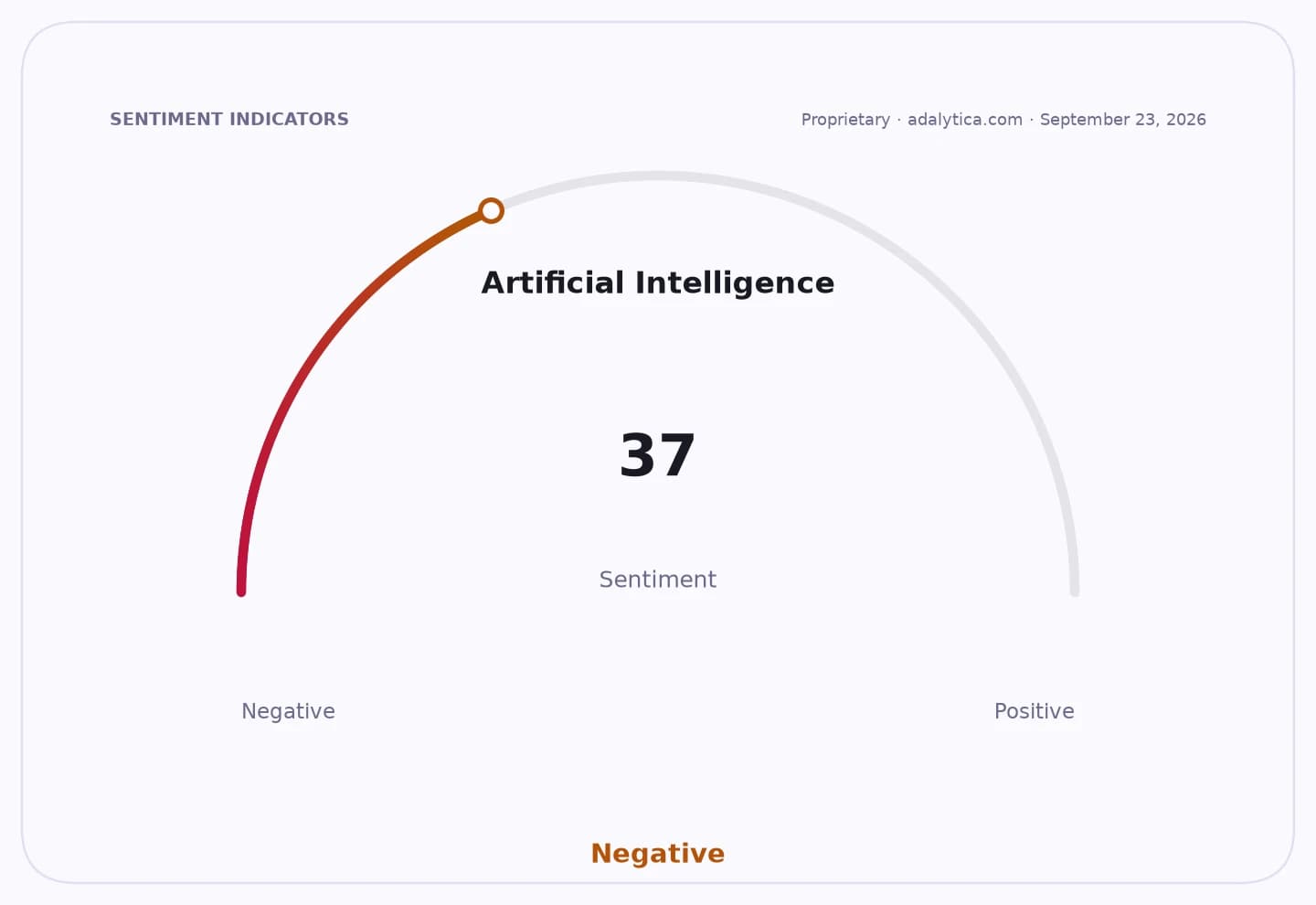
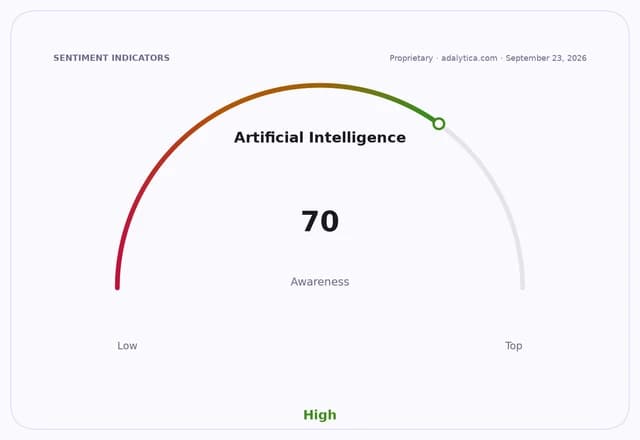
Sentiment IndicatorsⓘProprietary · adalytica.com · September 23, 2026
This is a snapshot — live sentiment, awareness and momentum for 130+ markets update continuously in the dashboard.Open AlphaPulse
The research points to a familiar problem for markets trying to price the AI boom: the evidence base is thin, backward-looking and heavily skewed toward rich economies. Of 138 studies mapped by the researchers, only 74 make any claim about jobs or wages, and 70% of those rely on exposure measures, simulations or projections rather than observed outcomes. The reported range is wide enough to support almost any headline, with estimates spanning from a 20% drop to a 25% gain in employment and from a 34% fall to a 40% rise in wages.
What does look more durable is a shift in how labor is organized. The study says benefits and harms often arrive through the same channel: monitoring can improve safety but erode privacy, and automation can eliminate tedious work while also removing the buffers between harder tasks. That matters economically because it affects productivity, employee retention and the cost of managing firms, not just payrolls.
The market implications are clearest in office-heavy sectors. The report says hiring at the bottom of the ladder has slowed in some advanced economies, and in the U.S. workers aged 22 to 25 in the most exposed occupations have lost ground relative to older peers. The broader labor backdrop is already soft, with the U.S. unemployment rate at 4.1% in August and payroll openings at 7.271 million in July, so AI is landing in a market that is not particularly forgiving for new entrants.
That makes the investor angle more nuanced than a simple “AI kills jobs” trade. If companies can use AI to compress layers of management, alter workflows and keep output growing without adding headcount, margins could improve even if employment data stay stable. But the same transition raises execution risk, especially for software, consulting and customer-service groups selling AI tools into organizations that may not yet have the skills to use them well.
Microsoft and Adobe show the divide. Microsoft shares have rebounded to $501.61, with the stock trading above its 200-day moving average and the 50-day average after a sharp summer selloff, reflecting persistent investor confidence that AI can expand enterprise spending and support earnings. Adobe, by contrast, has struggled to translate AI product investment into sustained stock performance; the shares closed at $249.52 on Sept. 21, below both the 50-day and 200-day averages, a sign investors remain skeptical about monetization and the pace of adoption.
The research also underscores a geographic split that could matter for global growth and labor supply chains. In the Global South, where informal work accounts for about 60% of employment and much of the evidence base is missing, AI could hit the “good jobs” that support middle-class entry, especially in outsourced service hubs such as the Philippines and India. That raises a risk that automation accelerates informality rather than broadening participation.
For companies, the immediate challenge is less about replacing workers than retraining them to manage AI systems and agents. The LSE seminar’s description of everyone becoming a manager because everyone now has to oversee digital agents captures the next phase of the transition: work is being reorganized around oversight, judgment and prompt-setting, not just machine substitution.
That is why the next phase of this story will matter most to investors: evidence on productivity gains, wage pressure and hiring patterns in exposed occupations, especially in the U.S., Europe and outsourced services. For now, the biggest economic change is not the disappearance of jobs, but the rewiring of the job itself.
| Entity | Gains | Losses |
|---|---|---|
| Microsoft | ▲AI-driven enterprise demand | ▼Firms slow to adopt AI workflows |
| Adobe | ▲AI adoption if monetization improves | ▼Investors wary of weak AI payback |
| White-collar workers | ▲Higher productivity tools | ▼Entry-level hiring and task autonomy |
| Global South outsourcing hubs | ▲AI services expansion | ▼Call-center jobs and informal labor buffers |