Workday shares are under pressure after a stretch of sharp gains, with the stock falling to $174.52 on Nov. 20 from $196.63 a month earlier as a new 8-K deal disclosure and a broader risk-off mood collide with a growing debate over whether more time at work actually means more productivity.
Workday Shares Fall on 8-K and Risk-Off Mood
The move matters because investors are already questioning how much revenue growth can justify software valuations in a labor market where firms are trying to do more with less. Workday’s price action has been volatile, with its 50-day moving average at $192.58 and the share price now well below that level, while the RSI has slid to 26.3, a reading that points to oversold conditions in conventional technical analysis.
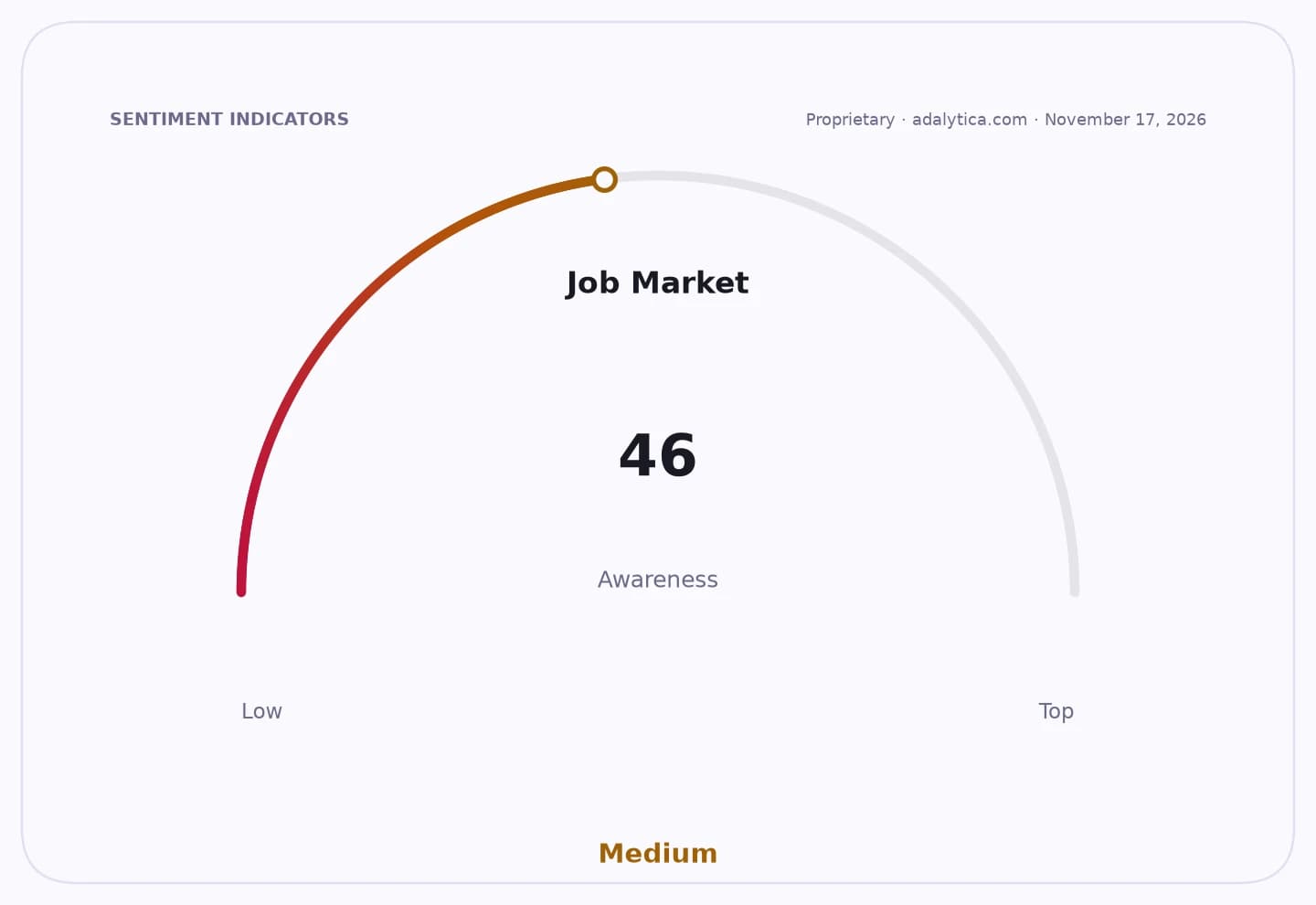
Sentiment Indicators
The broader backdrop is a work-world story that hits at the heart of enterprise software demand: employees are increasingly finding ways to look busy rather than be productive. A Swiss reporting project on “paid for 8 hours, worked for 4” describes office workers using mouse jigglers, fake status tools and other tricks to mask downtime, while companies respond with monitoring software and tighter controls.
That dynamic matters economically because it underscores a mismatch between time spent and output, especially in office-heavy sectors where software subscriptions, workflow tools and employee monitoring systems compete for budget. It also helps explain why managers are leaning harder on efficiency tools and why firms such as Workday must sell a return-on-investment story, not just headcount management.
Job Market vs WDAYadalytica.com
Explore this data interactively — full history, time series and cross-market comparisons.
Adalytica’s Job Market Sentiment snapshot has collapsed to 4.0, labeled “Extreme Fear,” while consumer confidence sentiment sits at 32.0, suggesting employers and households are both getting more cautious. For investors, that points to a tougher sales environment for workplace software, even as customers seek tools that can track productivity, automate routine tasks and reduce waste.
Workday’s recent decline leaves the stock still above its 200-day moving average of 156.34, but the gap has narrowed quickly. The key question now is whether demand for labor-efficiency software can offset slower corporate hiring and a more skeptical spending backdrop when the company next reports.
| Entity | Gains | Losses |
|---|---|---|
| Employers | ▲More visibility into output | ▼Higher monitoring costs |
| Software vendors | ▲Demand for efficiency tools | ▼Slower enterprise spending |
| Workers gaming the system | ▲More room to hide downtime | ▼Tighter surveillance |
| Workday shareholders | ▲Potential long-term AI/productivity upside | ▼Near-term valuation pressure |