Walmart, Target and Costco are moving in different ways, but the common thread is that investors are still treating U.S. consumer demand and retail labor as the central trade-off for the sector: stronger spending can support sales, but it can also force chains to hire, pay up and protect margins.
Walmart, Target, Costco Trade on Retail Labor
That matters because retail payrolls are one of the clearest real-time measures of whether executives believe demand is durable enough to justify staffing ahead of the holiday season and into next year. For large-format discounters, warehouse clubs and big-box chains, labor is not just an operating expense; it is a signal of traffic expectations, inventory discipline and pricing power.
Sentiment IndicatorsⓘProprietary · adalytica.com · September 23, 2026
This is a snapshot — live sentiment, awareness and momentum for 130+ markets update continuously in the dashboard.Open AlphaPulse
Walmart’s shares recently rose to 110.21, above their 50-day moving average of 109.54, after recovering from a sharp mid-year slump that pushed the stock below 109 in July. The move comes with RSI readings near 65, suggesting momentum has improved without showing the kind of extreme overbought conditions seen earlier this year. For investors, that keeps Walmart in the frame as the defensive beneficiary if consumer spending remains resilient but uneven.
Target remains the clearest turnaround case. The stock has climbed to 158.07 from 81.44 in late November, a near-doubling that has dramatically reset expectations for the retailer’s turnaround and margin repair. Technical indicators show the shares still comfortably above the 50-day average of 152.17 and well above the 200-day average of 124.73, though RSI at 38.8 points to a pause after a powerful run. If hiring and traffic data stay firm, the market will be watching whether Target can convert that operating leverage into sustained earnings momentum rather than a short-covering rally.
Costco, by contrast, looks more like a quality compounder under pressure. The shares trade at 898.15, below both the 50-day average of 935.38 and the 200-day average of 958.03, after a steep pullback from August’s 1,092.58 high. RSI around 25 suggests the stock is technically washed out, but that does not automatically make it cheap in fundamental terms. Costco’s appeal has always been steady membership income and premium valuation support; if retail employment stays firm and spending sentiment remains elevated, the stock can recover, but it will likely need proof that traffic and basket sizes are still holding up against a more cautious backdrop.
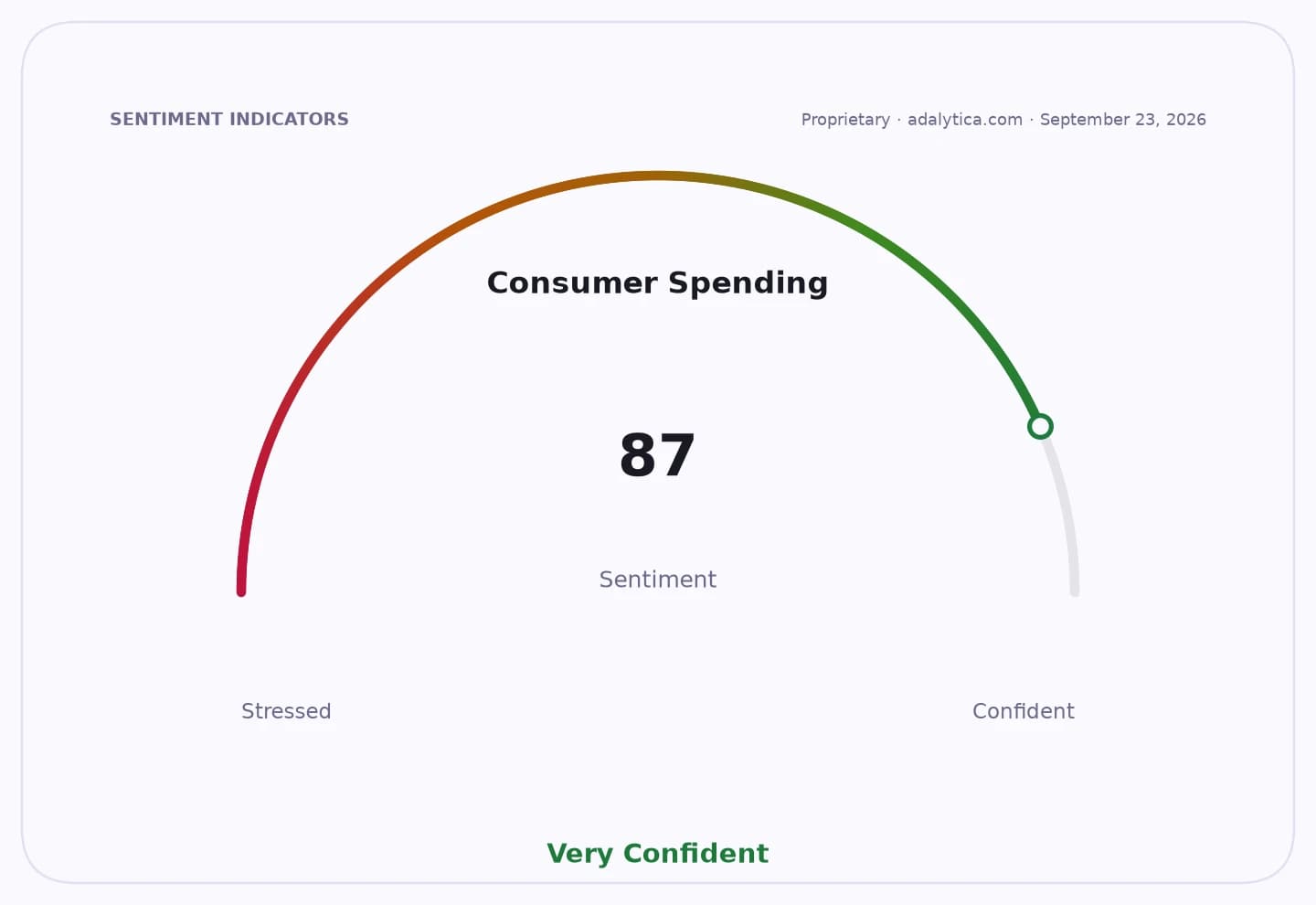
The broader consumer backdrop is still supportive. Adalytica’s consumer spending sentiment sits at 87, labeled extreme greed, while consumer confidence sentiment is at 100, also in extreme greed, indicating households are not behaving as if a recession is imminent. That combination supports discretionary traffic and makes it easier for retailers to justify hiring, especially in service-heavy formats where labor is directly tied to sales execution.
For investors, the key issue is whether strength in spending translates into durable margin expansion or simply higher payroll costs. Walmart tends to benefit first from any shift toward value-seeking shoppers; Target benefits if the consumer remains healthy enough to trade up; Costco depends on membership retention and steady traffic rather than short-term sentiment. If hiring accelerates, the winners will be the retailers with scale and productivity leverage. If demand cools, the market will punish the names that expanded payrolls fastest.
| Entity | Gains | Losses |
|---|---|---|
| Walmart | ▲Value traffic and defensive demand | ▼Margin if labor costs rise |
| Target | ▲Turnaround leverage and higher sales | ▼If momentum fades after rally |
| Costco | ▲Traffic from resilient consumers | ▼Premium valuation support |
| Retail workers | ▲More hiring and hours | ▼Slower wage growth if demand cools |