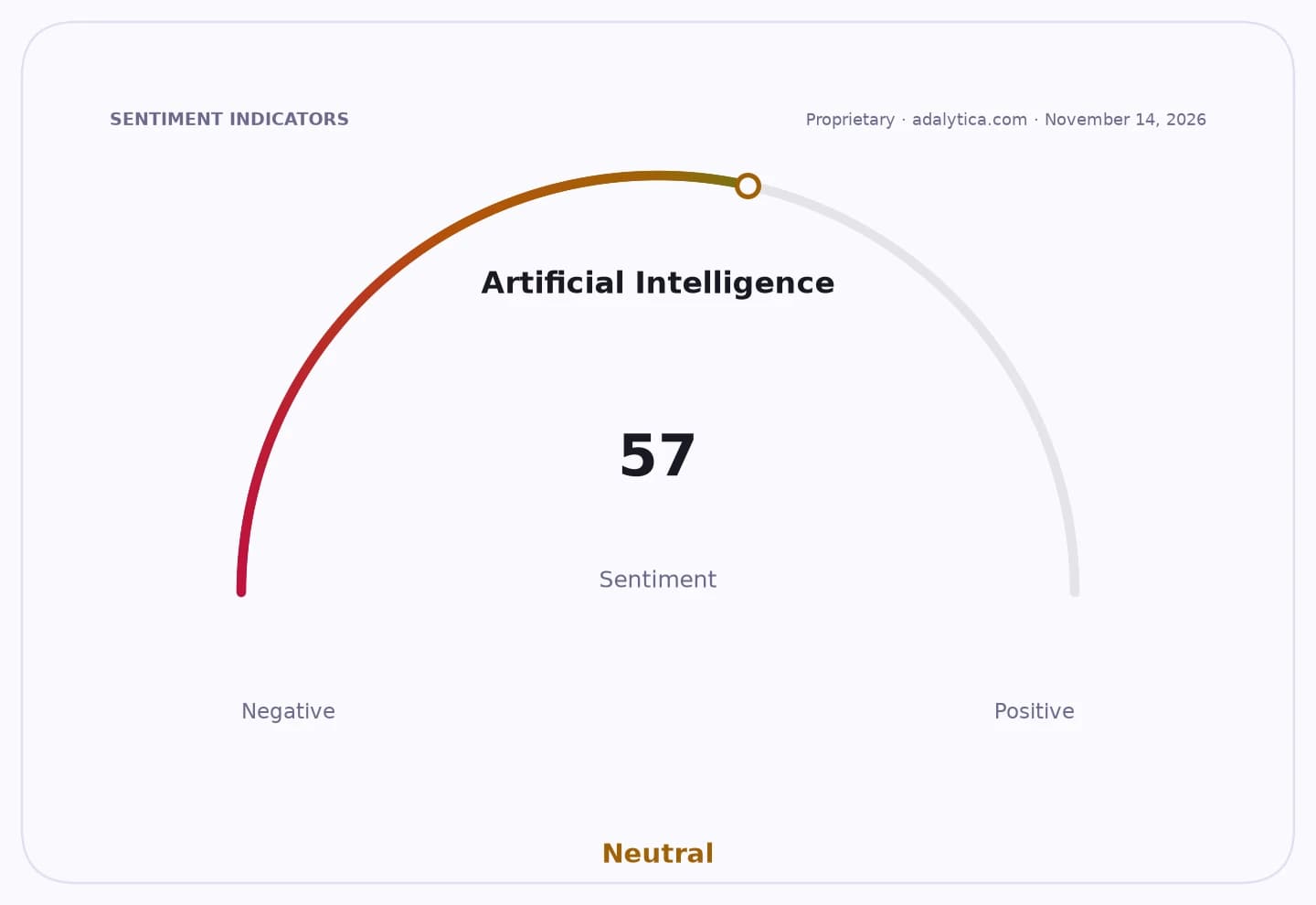
AI-generated content is showing up far more often in University of Michigan administrative communications, even as the school asks students and faculty to disclose or restrict their own use of the technology.
University of Michigan AI Use in Administrative Communications
Artificial Intelligence
That matters because the issue is no longer whether AI is part of campus operations, but whether the university is applying the same standards to its leadership that it expects from the rest of the institution. For investors, policymakers and higher-education peers, the story points to a broader governance risk: institutions moving faster on AI adoption than on rules for accountability, privacy and disclosure.
Sentiment Indicators
A review of more than 800 public documents by The Michigan Daily found no AI-generated content in 297 administrative documents published before ChatGPT launched in late 2022. Use did not appear immediately after that, but it climbed sharply in 2025 and then accelerated again in 2026. By that year, AI was detected in 32.4% of direct communications from the president’s office and the Board of Regents, and in 14.7% of University Record articles published by the Office of Public Affairs and Communications.
The numbers matter because they show AI moving from an experimental tool to part of routine institutional messaging. In practical terms, that can speed up drafting and standardize language, but it also raises the risk of homogeneity, factual slippage and blurred accountability when official statements are partially machine-assisted. At a university that has built its public brand around responsible technology use, the gap between the rhetoric and the practice is becoming material.
Michigan’s own six AI principles, released Oct. 21, call for “human-centric” use, privacy, ethics, transparency and support for critical thinking. Yet the administration has not issued university-wide rules for administrative units, according to spokesperson Kay Jarvis, who said offices are adapting in different ways to AI technology. The Office of Public Affairs has its own generative AI guidelines, but regent and presidential communications do not appear to have comparable public standards.
That asymmetry is the core of the story. Students and faculty are being asked to navigate AI bans, disclosure requirements and course-by-course restrictions, while the administration is using the same technology in official communication with limited public visibility. That creates a reputational risk for the university and a governance problem for other institutions watching how to integrate AI without eroding trust.
Michigan’s stance also comes against a backdrop of heavy institutional commitment to AI. The university has invested $20 million of its endowment in OpenAI, backed AI development in Ypsilanti Township and launched its own U-M GPT tool before putting formal governance in place. That sequencing suggests AI is being treated as a strategic priority, but one that has outpaced internal controls.
For supporters, the rise in AI use may simply reflect efficient adoption of a general-purpose technology that can help staff work faster and communicate more consistently. For critics, it shows a public institution asking for transparency from students while leaving its own processes opaque. The central question is not whether AI should be used, but whether the university can prove that its use strengthens, rather than dilutes, the mission it says it serves.
The next pressure point will be whether Michigan publishes unit-level AI policies for administrative communications and whether it applies the same disclosure standards to leadership that it expects across campus. If it does not, the university risks turning its own AI principles into a credibility test it is failing in public.
| Entity | Gains | Losses |
|---|---|---|
| University administration | ▲Faster drafting, workflow efficiency | ▼Credibility, transparency |
| Students and faculty | ▲None directly | ▼Higher disclosure burden, uneven standards |
| Office of Public Affairs | ▲Easier content production | ▼Trust in official communications |
| AI vendors / tools | ▲Deeper institutional adoption | ▼Scrutiny over governance and use |