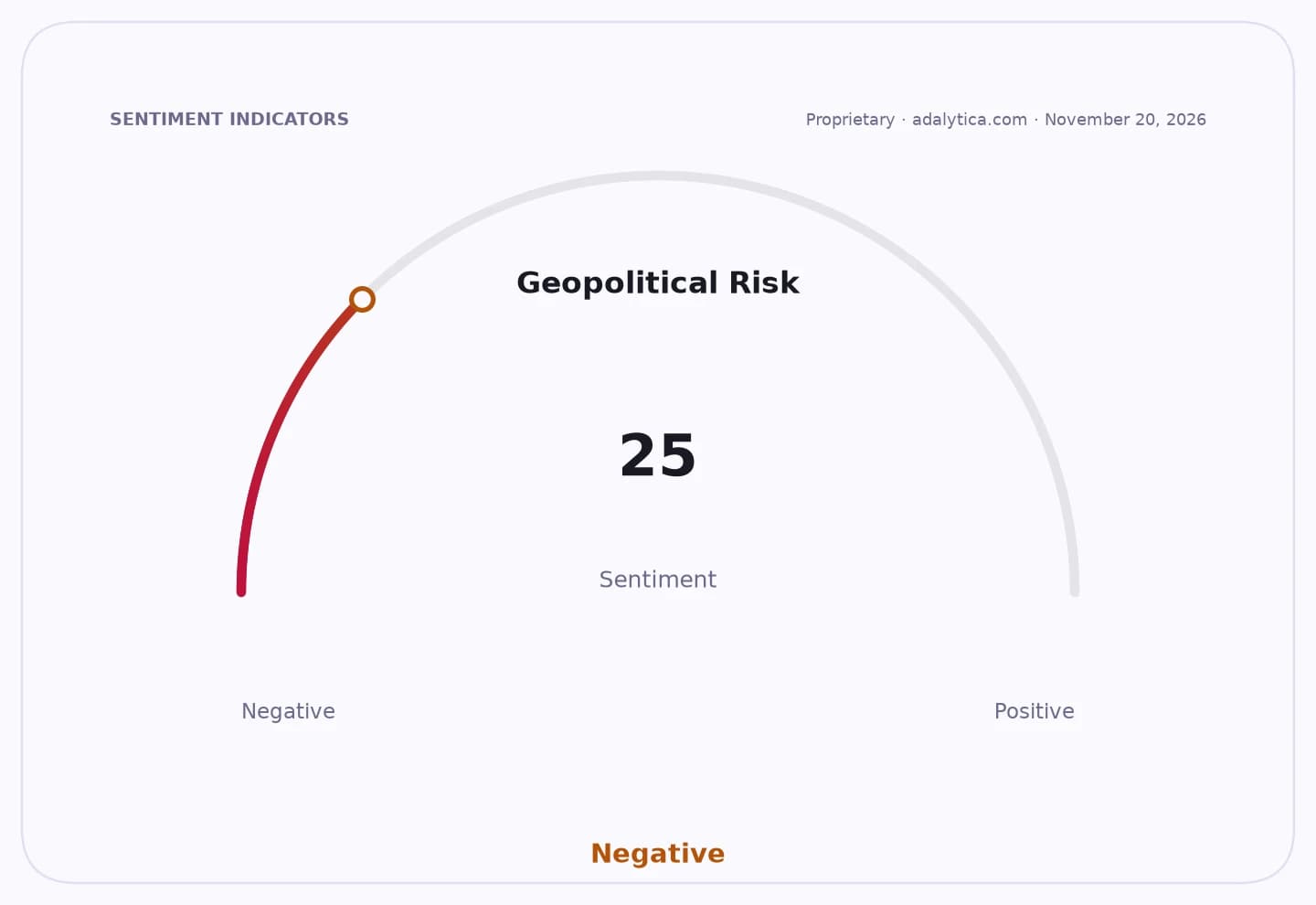
Pedro Sánchez’s pre-campaign warning in Bilbao that Spain will not become “the backyard of any far-right international” lands at a delicate moment for investors: the November 29 election is increasingly shaping up as a referendum on political stability, housing affordability and the durability of Spain’s reform path.
Spain election risk lifts focus on EWP

That matters because markets do not trade rhetoric in isolation. They trade policy direction, coalition arithmetic and the likelihood that a government can keep reforms moving while social tensions rise. With the opposition People’s Party ahead in polls and the campaign shaped by riots, a deadly train disaster and housing protests, Spain’s political risk premium is no longer theoretical. It is now part of the investment case for Spanish assets.
Sentiment Indicators
The clearest market read is in the iShares MSCI Spain ETF, EWP, which has recovered to $59.81 after a volatile year that saw it sink to $50.82 in March before rebuilding above both its 50-day and 200-day moving averages. The recent move higher, backed by a bullish turn in MACD and an RSI above 60, suggests traders are leaning into Spain’s domestic resilience even as the election risk sharpens. That makes the next few weeks important: if polls continue to favor the PP, investors could start pricing a cleaner policy transition; if Sánchez narrows the gap, the market may keep betting on continuity and coalition compromise.
Spain’s election also matters beyond Madrid. The euro zone has become an increasingly crowded trade, with the broad euro trade gauge in “Extreme Greed” and broad European equity exposure through EZU and EWG holding near recent highs. For now, the market is not treating the Spanish vote as a systemic threat. But that is exactly why the setup is interesting: consensus often underprices second-order political risk until the final stretch of a campaign.
Euro vs EWPadalytica.com
Explore this data interactively — full history, time series and cross-market comparisons.
For investors, the opportunity is not to chase headlines but to position for volatility in the parts of the market most exposed to domestic policy. Spanish banks, construction names, infrastructure operators and housing-linked sectors are the obvious transmission channels if the election changes the pace of regulation, spending or reform. A stable, market-friendly outcome could support the ongoing recovery in Spanish equities. A sharper turn toward populist confrontation would likely hit sentiment first and valuations second.
The bigger lesson is that Spain is becoming a test case for Europe’s next political trade. The market is rewarding stability, but the campaign is reminding investors that housing anger, migration politics and anti-establishment backlashes can move capital quickly when polls tighten. Our view is simple: keep Spain on the radar, favor quality exposure over broad beta, and be ready for a fast repricing if the election narrative shifts again.
| Entity | Gains | Losses |
|---|---|---|
| PP-led stability trade | ▲Investors seeking policy clarity | ▼Sánchez’s coalition narrative |
| EWP / Spanish equities | ▲Continuity and reform hopes | ▼Election-driven volatility |
| Domestic banks and cyclicals | ▲Clean transition, stronger confidence | ▼Populist policy uncertainty |
| Europe-wide risk assets | ▲Spain stays contained | ▼If Spanish politics spills into broader euro sentiment |