Slovenia is set to adjust its minimum wage to inflation this year, a move that will raise labor costs for employers while cushioning the lowest-paid workers against a faster rise in prices.
Slovenia Minimum Wage to Rise With Inflation
If the government follows the Autumn Forecast from the Office for Macroeconomic Analysis and Development, which sees inflation at 3.1% this year, the gross minimum wage would rise to about 1,528 euros, from the current level implied by the existing wage floor. That would make the increase largely automatic rather than discretionary, limiting the scope for a last-minute political compromise and signaling that wage-setting is being tied more closely to macroeconomic conditions.
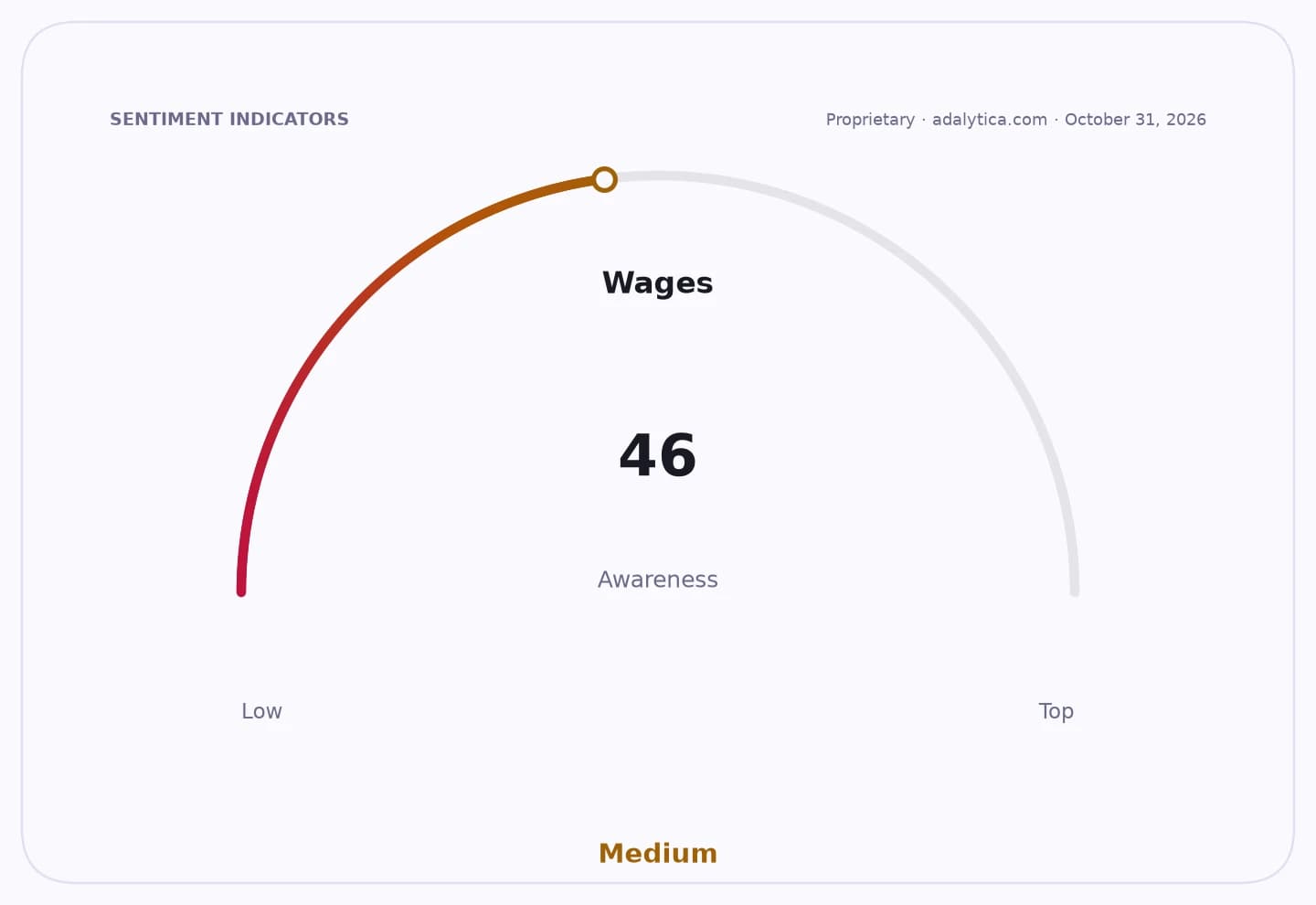
Sentiment Indicators
The change matters because minimum-wage policy feeds directly into household consumption, business margins and the broader wage structure. For workers near the floor, even a modest increase helps preserve real income after several years of inflation shocks across Europe. For employers, especially in labor-intensive sectors such as retail, hospitality and services, an inflation-linked adjustment raises payroll bills at a time when firms are already managing softer demand, higher financing costs and weaker profit buffers.
Unions have broadly welcomed the shift, while acknowledging there are still unresolved questions over which inflation measure should be used to calculate the adjustment. Jakob Počivavšek, head of the Pergam trade union confederation, said the principle was acceptable but noted “certain dilemmas” remain about the benchmark used to set the wage. On the employers’ side, the Chamber of Commerce’s Mitja Gorenšček said firms expected no outcome below the legal minimum, underscoring that the real debate is over how large the increase will be, not whether there will be one.
The timing is also important. Minimum-wage decisions in Slovenia have typically been set at the end of January, after companies had already started operating in the new business year. Bringing the adjustment earlier and tying it more explicitly to inflation gives firms more visibility, but it also reduces flexibility if price pressures re-accelerate. That is where the broader macro picture matters: even as inflation has cooled from its peaks, it remains high enough to keep wage demands politically sensitive and economically consequential.
For investors, the key implication is that the policy supports domestic demand but also reinforces cost pressure in sectors with thin margins and limited pricing power. The wage floor can lift spending among lower-income households, which is positive for retailers and consumer-facing businesses. But it can also squeeze small employers, accelerate wage drift across the labor market and increase the risk that firms pass costs through to prices, keeping inflation stickier than otherwise.
The next catalyst is the government’s final decision on the adjustment formula and exact figure. If officials settle on the forecast inflation rate, the move will amount to a broadly mechanical uplift. If they opt for a different benchmark or a larger political increase, the effects on business costs, employment decisions and price-setting behavior could be more pronounced.
| Entity | Gains | Losses |
|---|---|---|
| Low-wage workers | ▲Higher gross pay | ▼Inflation still erodes real gains |
| Labor unions | ▲Policy victory | ▼Less room for bigger hike |
| Employers | ▲More wage clarity | ▼Higher payroll costs |
| Consumers | ▲Support for household spending | ▼Possible pass-through to prices |