Nvidia’s message that “local AI is here” points to a bigger commercial shift: the first meaningful attempt to move everyday AI workloads out of the cloud and onto devices people own, a change that could reshape consumer spending, privacy trade-offs and competition across the AI stack.
Nvidia Local AI Push Targets PCs and Laptops

The argument is not that a home computer will replace the most powerful frontier models overnight. It is that a growing slice of practical AI tasks — drafting emails, summarizing documents, searching files, running coding assistants and automating personal workflows — may no longer need a remote data center at all. That matters economically because it changes the cost model from recurring cloud usage to one-time hardware sales, while also reducing the marginal expense of each prompt for the user.
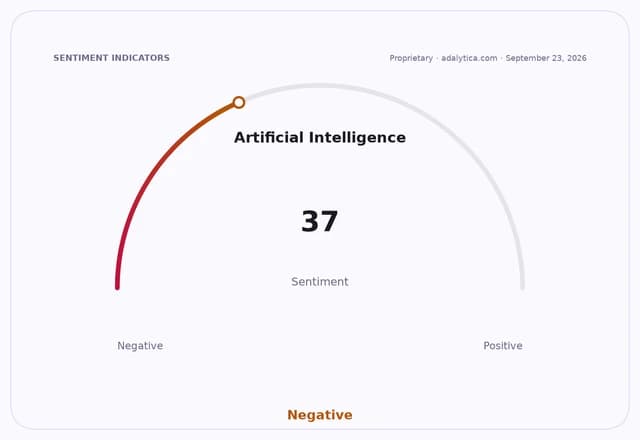
Sentiment IndicatorsⓘProprietary · adalytica.com · September 23, 2026
This is a snapshot — live sentiment, awareness and momentum for 130+ markets update continuously in the dashboard.Open AlphaPulse
The clearest evidence is Nvidia’s DGX Spark, which is already being used at home by the company’s product chief, Adel el Hallak. The system retails for $4,699 and can run overnight jobs without making noise, a detail that underlines Nvidia’s effort to normalize AI hardware as a domestic appliance rather than a lab machine. Against a ChatGPT Plus subscription at $20 a month, the hardware looks expensive up front but increasingly plausible over a multi-year horizon for users who want unlimited queries, no per-token billing and no internet dependency.
That pricing math is only part of the appeal. The bigger draw is data control. Local execution keeps files and prompts on the user’s machine, a feature that should resonate as AI agents move deeper into email, calendars, finance and other sensitive personal data. In that sense, Nvidia is not just selling compute; it is selling ownership, autonomy and privacy. For consumers, those are becoming product features rather than abstract concerns.
The story also has a market dimension. Nvidia is broadening the addressable market for its Blackwell-era silicon beyond data centers to PCs and laptops, a move that could open a new upgrade cycle if the software layer becomes simple enough for mainstream users. RTX Spark laptops from Dell, HP, Lenovo, Asus, MSI and Acer are expected to ship this fall, and Microsoft is building a Surface Laptop Ultra around the chip. If that ecosystem develops, Nvidia could extend its dominance from server accelerators into a premium AI-PC category.
That is where the competition starts to matter. AMD has argued in filings that demand for its AI products has surged, while Qualcomm has made on-device AI central to its consumer thesis. Intel, meanwhile, is trying to regain relevance in client computing as AI features become a selling point for premium PCs. Nvidia’s advantage is the combination of high memory capacity and the CUDA software stack, which may give it an edge in running larger local models that would overwhelm typical consumer GPUs.
Investors should see two possible outcomes. In the bullish case, local AI becomes the next major upgrade cycle, supporting hardware demand, ecosystem lock-in and broader AI adoption at the edge. In the bearish case, the shift fragments AI usage, pressuring cloud subscriptions and commoditizing some workloads before hardware margins fully compensate. The likely near-term result is a mixed one: the most capable models remain cloud-based, but enough everyday tasks migrate locally to change buying behavior.
The stock tape suggests Nvidia is still being treated as the dominant AI platform, though not without volatility. The shares were recently trading around $227, above both the 50-day and 200-day moving averages, with a neutral-to-firm relative strength reading and a positive MACD setup, indicating the market remains willing to pay for the company’s AI optionality. But the investment case now depends not only on data-center demand, but on whether Nvidia can turn local AI into a mass-market category.
The broader narrative is simple: if AI is becoming a personal utility, the winning companies may be those that make it cheaper, private and always on. Nvidia is trying to make sure it supplies the chips behind that transition, whether the model runs in a cloud rack or in a laptop on the kitchen table.
| Entity | Gains | Losses |
|---|---|---|
| Nvidia | ▲New hardware demand | ▼Cloud-only positioning |
| Consumers | ▲Lower long-run AI costs | ▼Subscription dependency |
| Cloud AI providers | ▲— | ▼Usage volume, prompt revenue |
| PC makers | ▲Premium upgrade cycle | ▼Commodity laptop pricing |