Nvidia is still the king of AI chips, but the bigger investment story now is that its market may be shifting from scarcity to substitution.
Nvidia Faces More AI Chip Competition

That matters because Nvidia’s extraordinary margins were built not just on demand, but on a premium that customers were willing to pay for performance, software and ecosystem lock-in. If AI models can move more easily across accelerators, that premium gets harder to defend. In a world where chips become more fungible, investors should think less about who sells the most expensive GPU and more about who captures the wider buildout of AI infrastructure.
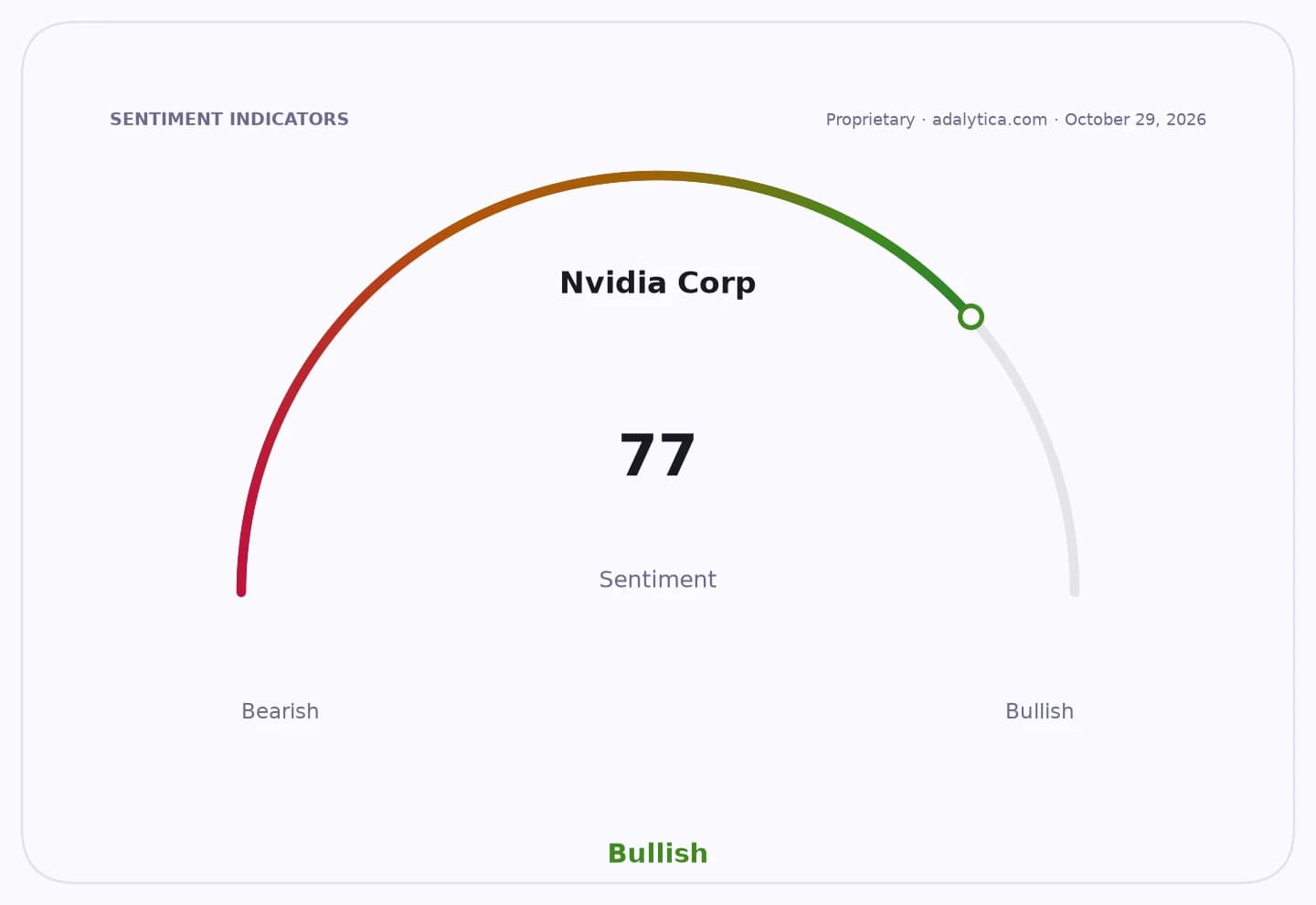
Sentiment Indicators
Nvidia Corp
The first signs are already showing up. Anthropic said its Claude model could be moved onto alternative chips in days with little human intervention, a process that once took months and specialized engineering teams. That is exactly the kind of shift that weakens Nvidia’s CUDA moat. Semianalysis has also argued that Alphabet’s Tensor Processing Units now outperform Nvidia’s GPUs on a performance-per-dollar basis, while AMD’s newer accelerators are gaining traction thanks to larger memory capacity and improving software support.
For Nvidia, the risk is not just slower share gains. It is margin compression. Nvidia’s gross margin has been running in the mid-70% range, far above AMD’s mid-50s, and that gap reflects pricing power as much as product quality. If customers increasingly view AI chips as interchangeable, the market is likely to reward lower-cost alternatives and squeeze the premium that Nvidia has enjoyed for years. That is why the latest weakness in Nvidia shares matters: the stock is no longer just trading on growth, but on whether investors still believe its moat is as wide as before. Technical indicators underscore that pressure, with Nvidia trading far below its 50-day and 200-day moving averages and its relative strength reading deeply oversold.

Still, this is not a story about Nvidia being broken. It is a story about AI hardware becoming a more competitive market. Nvidia remains strong in networking, software integration and supply-chain access, especially around high-bandwidth memory and advanced packaging through Taiwan Semiconductor Manufacturing. But in investing, dominance is not the same as immunity. Even the best companies can see returns normalize when an industry matures.
That maturation is why Taiwan Semiconductor Manufacturing may be one of the biggest beneficiaries. Whether customers buy Nvidia GPUs, AMD chips or custom silicon from companies such as Broadcom and Marvell, most of that demand still runs through TSMC’s manufacturing funnel. Lower AI chip prices could actually broaden the market, raise overall wafer demand and reduce TSMC’s dependence on any one customer. For long-term investors, that is the kind of setup that can support durable compounding.
Alphabet is another likely winner. It has spent more than a decade developing custom TPUs, and that early lead could now turn into a real advantage as AI workloads become more portable. Alphabet can use its own chips to improve data center efficiency while also offering a lower-cost alternative to outside customers without giving up economics. In a market where performance-per-dollar matters more than raw benchmark bragging rights, that is a meaningful edge.
AMD may be the most obvious levered play. It starts from a smaller share base, its business model is already built around thinner margins, and its newer systems — including Helios — are aimed directly at customers looking for an alternative to Nvidia at lower price points. As inference and agentic AI gain importance, memory capacity, CPU integration and cost per action matter more than bragging rights on training clusters. That favors AMD’s pitch.
There is also a broader backdrop here. Tightening U.S. export controls on AI chips and closing loopholes through third countries may slow some regional buildout, especially in Southeast Asia, but they do not reverse the commoditization trend. If anything, they remind investors that the AI chip market is becoming more strategic, more fragmented and more contested at the same time.
For long-term investors, the takeaway is simple: Nvidia may still be the best-known AI winner, but a more competitive chip market could shift some of the value chain’s biggest gains to manufacturers and lower-cost challengers. If you are building a portfolio for the next three to 10 years, TSMC, Alphabet and AMD are worth keeping on the watchlist — and Nvidia remains a company to own only with the understanding that its moat is no longer unchallenged.
| Entity | Gains | Losses |
|---|---|---|
| TSMC | ▲More AI wafer demand | ▼Customer concentration risk |
| Alphabet | ▲TPU share gains | ▼Nvidia dependency |
| AMD | ▲Share gains on lower prices | ▼Nvidia’s premium pricing |
| Nvidia | ▲Ecosystem strength | ▼Margin and pricing power |