Nvidia CEO Jensen Huang’s decision to stand by his forecast for as much as $4 trillion in annual data center spending by 2030 keeps the market focused on the scale of the AI build-out — and on how much of that capital ultimately flows to Nvidia.
Nvidia Reaffirms $4 Trillion Data Center Spending View
The projection matters because it frames AI not as a short-lived upgrade cycle but as a multi-year infrastructure replacement wave. If global data center capital expenditure really rises from roughly $1 trillion this year toward $3 trillion to $4 trillion by the end of the decade, the spending base available to Nvidia, its suppliers and its customers would expand dramatically. For investors, that raises the stakes around Nvidia’s ability to keep its dominant position in AI accelerators while the industry shifts from early-stage facility construction to much heavier server and chip deployment.
Sentiment Indicators

Huang’s thesis is that the current spending surge is still in the early innings. The biggest hyperscalers alone are expected to spend nearly $800 billion this year on data center capex, and that figure excludes smaller cloud providers, enterprises and sovereign-backed buyers. Nvidia argues that much of today’s capital is going into land, power, buildings and networking, with the chip-heavy phase still ahead as projects move from planning to full deployment. That sequencing would support chip demand for longer than many investors assume, even if rivals continue pushing custom silicon.
The financial implications are enormous. Wall Street expects Nvidia to generate about $412 billion in revenue this year. If the broader market it serves truly triples or quadruples by 2030 and Nvidia preserves something close to its current share, revenue could climb into the low-trillion-dollar range. Even with margins well below current levels, that math implies a vastly larger earnings base than today. It is why bulls see the stock as still underappreciated despite a market value already above $5 trillion.
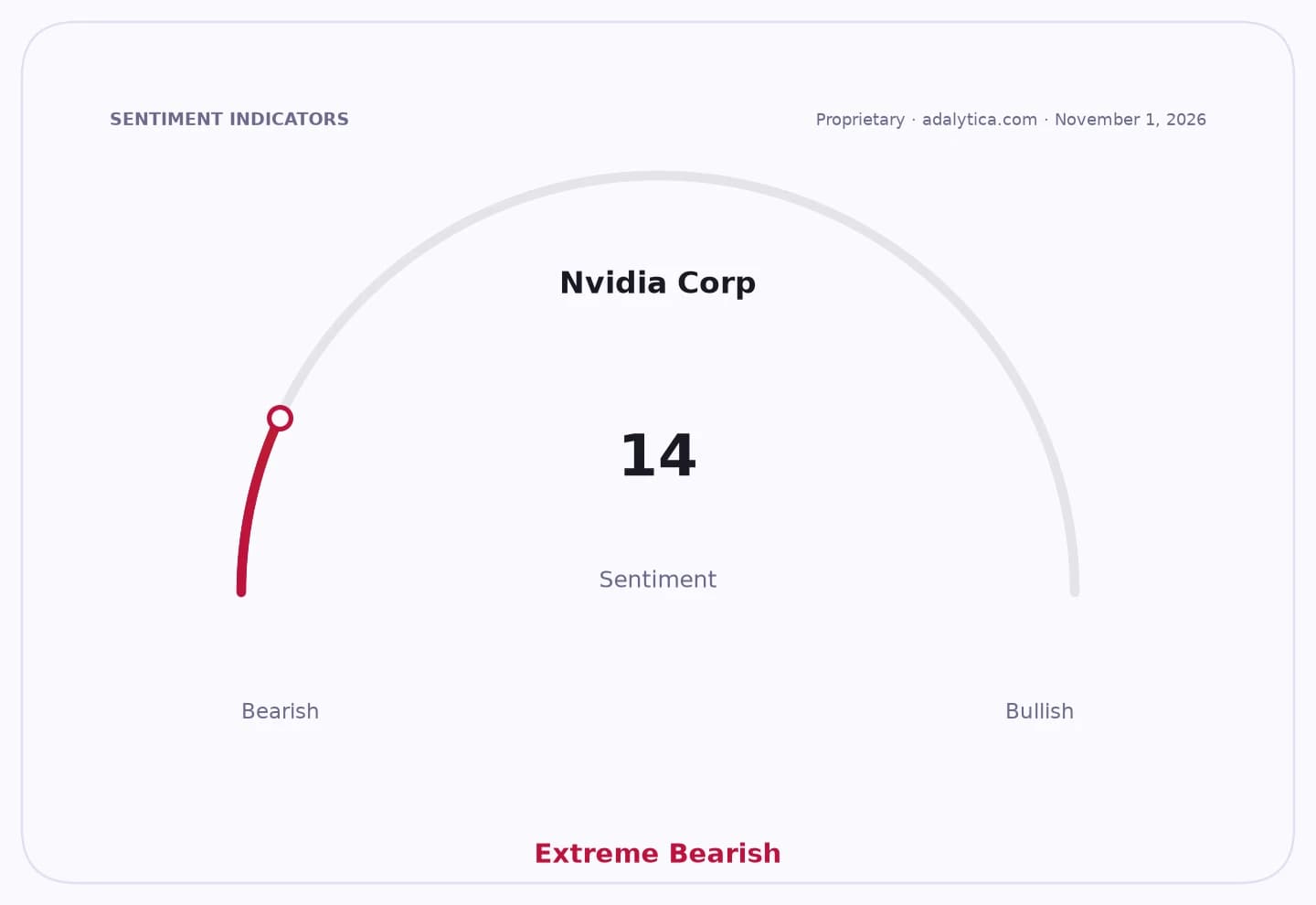
The stock price, however, shows that investors are no longer treating the AI trade as a straight line. Nvidia shares have been volatile, with the latest technical readings showing the stock below its 50-day moving average and RSI in the low 30s, a sign of fading near-term momentum rather than a collapse in the longer-term thesis. The semiconductor sector has been under pressure as well, with the SOXX ETF and the SMH ETF both trading below recent highs and their 50-day averages. Adalytica’s NVIDIA Earnings Sentiment gauge has also slipped back into “Extreme Fear,” underscoring how quickly enthusiasm has cooled after strong runs.
That disconnect between long-term opportunity and short-term sentiment is exactly where the market debate now sits. The bull case is straightforward: Nvidia remains the essential supplier in a capital-intensive AI cycle that is still scaling, and its access to customers’ deployment plans gives it visibility few outsiders have. The bear case is that competition from custom chips, tighter customer budgets and a possible normalization in AI infrastructure spending could compress both share and margins before the payoff arrives.
For now, the key investor question is not whether AI spending is large — it clearly is — but whether it remains large enough, long enough, to justify the premium attached to Nvidia’s earnings power. Huang’s reaffirmation says the company is still betting that the answer is yes.
| Entity | Gains | Losses |
|---|---|---|
| Nvidia | ▲Larger AI chip demand | ▼Short sellers |
| Hyperscalers | ▲Faster AI capacity build-out | ▼Cash flow |
| Semiconductor peers | ▲Sector demand spillover | ▼Margin visibility |
| Customers with AI budgets | ▲More compute supply | ▼Other capex priorities |