Nigeria’s biggest labor federation is pressing for a minimum wage formula that rises automatically with inflation, a demand that could reshape the country’s next pay round and put fresh pressure on public finances and private employers alike.
Nigeria Labor Congress Seeks Inflation-Linked Minimum Wage
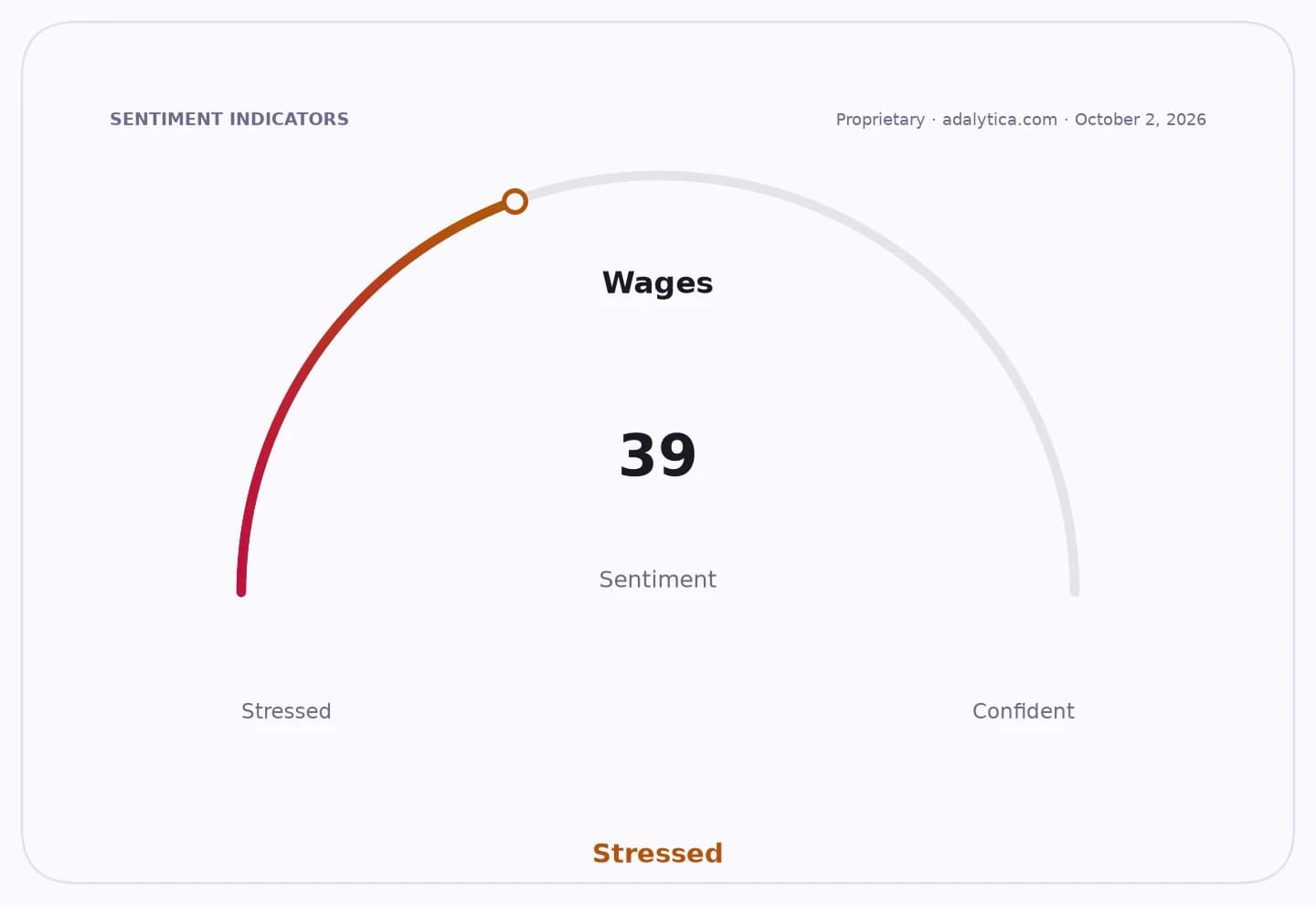
Wages
The Nigeria Labour Congress wants the 2027 wage review to be tied to the real cost of living — housing, transport, food and other essentials — rather than to a one-off headline increase. That matters because Nigeria’s last wage reset, in 2024, lifted the national minimum wage from 30,000 naira to 70,000 naira, but workers say the gain has already been eroded by inflation and a weaker naira.
Sentiment Indicators
CPI
For investors, the issue goes well beyond labor politics. A wage formula linked to inflation would make future payroll costs more predictable, but it would also risk locking in higher expenses for government budgets, banks, consumer companies, transport operators and other labor-intensive businesses. In a country already battling elevated prices and fragile household demand, any attempt to protect workers’ purchasing power could feed into broader inflation if companies pass on higher costs.
The NLC’s argument is straightforward: wage negotiations should not be reduced to bargaining over an arbitrary number such as 500,000 naira or 1 million naira, but should reflect measurable changes in living costs. Its president said any review should factor in rent, transport and food prices, and insisted the next round should begin in April 2027, in line with the three-year review cycle created by the 2024 law.
That detail matters because timing is part of the fight. Organized labor does not want the review pushed back by slow negotiations or for the government to treat the date a deal is signed as the start of the cycle. In practice, that could shape how quickly workers see relief — and how long employers have to prepare for higher labor costs.
The backdrop is a cost-of-living squeeze that has become one of Nigeria’s defining economic pressures. The NLC also criticized the limited relief from temporary transport support measures, including the rollout of compressed natural gas buses and a six-month extra payment, saying such steps cannot substitute for durable wage protection.
From an investing perspective, the long-term question is whether Nigeria is moving toward a more formal inflation-pass-through economy. If wages begin to adjust automatically, households may preserve some purchasing power, but businesses could face less flexibility on margins, and the government may confront a harder budget arithmetic at exactly the wrong time. That is especially relevant for companies exposed to consumer spending, public procurement and wage-sensitive demand.
There is also a political dimension. The Trade Union Congress used the same platform to warn workers not to sell votes and later expect labor to fight governments they helped elect, a reminder that wage talks in Nigeria are never just economic; they are electoral and institutional too. Labor leaders also pushed for unity between the NLC and TUC, which would strengthen their hand in any 2027 negotiation.
For now, the message for investors is simple: Nigeria’s wage debate is moving from a one-time increase to a structural discussion about indexation. If labor wins that argument, it could improve household resilience over time — but it would also mean a more expensive operating environment. Worth watching closely, especially for companies with thin margins and heavy local payrolls.
| Entity | Gains | Losses |
|---|---|---|
| Nigerian workers | ▲Better wage protection | ▼Less erosion from inflation |
| NLC and TUC | ▲Stronger bargaining power | ▼Less room for compromise |
| Government | ▲Political calm if deal holds | ▼Higher budget pressure |
| Employers | ▲More wage certainty if indexed | ▼Higher payroll and margin pressure |