Prime Minister Narendra Modi turned a Bihar rally into a defence of his economic model, saying his government has lifted 50 crore Indians out of poverty in 12 years and arguing that welfare delivery, not Congress-era slogans, is what changed lives on the ground.
Modi Defends India Poverty Reduction Model in Bihar
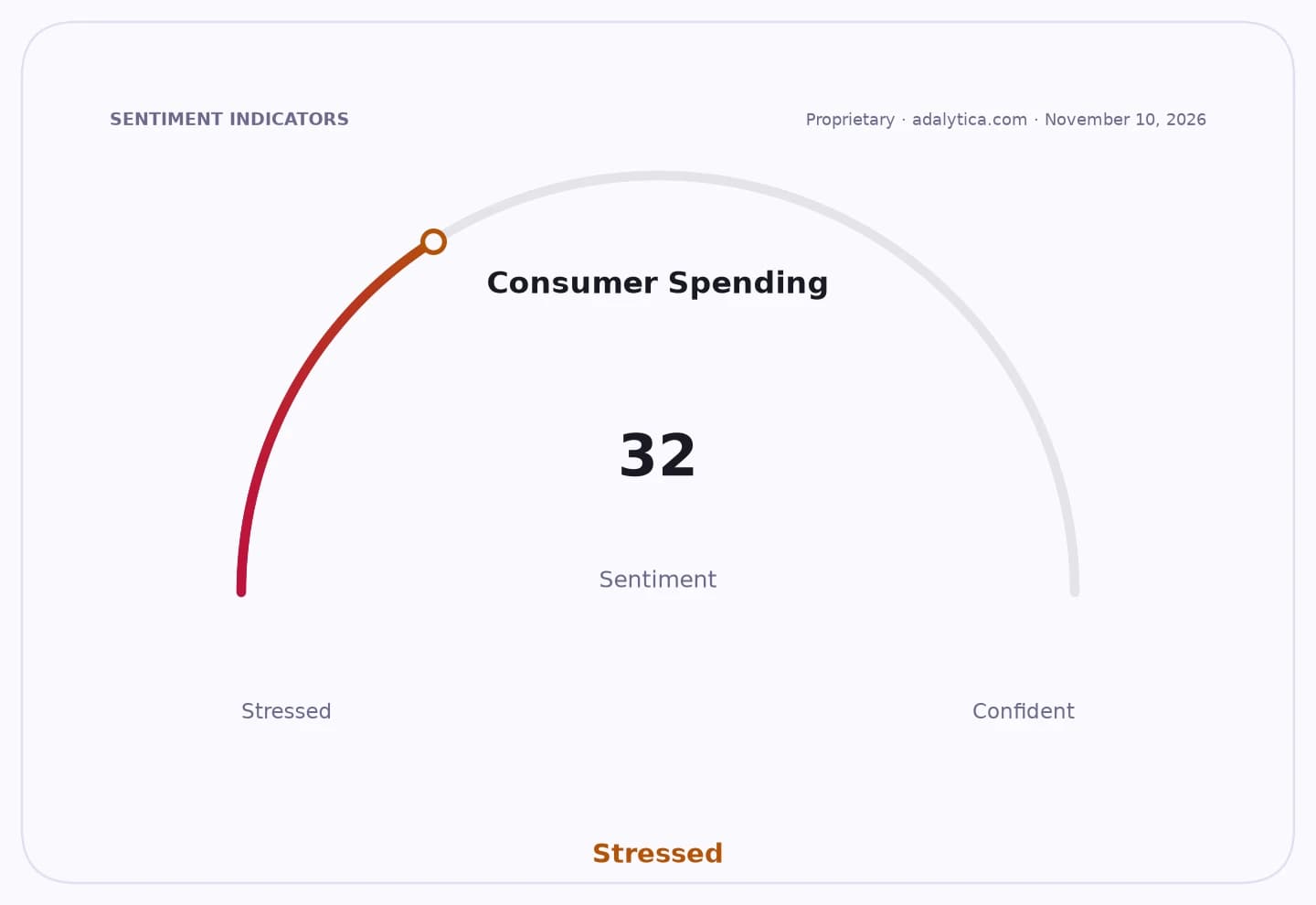
Consumer Spending
The claim matters because poverty reduction remains the most politically potent test of India’s growth story. Modi is using a headline social metric to reinforce a broader argument: that the BJP’s mix of cash transfers, free food, housing and health cover has translated macroeconomic expansion into visible gains for lower-income households, while also strengthening its electoral message ahead of key state battles.
Sentiment Indicators
At Vaishali, Modi said his government has provided free food grains to 80 crore people, permanent homes to millions of families and free medical treatment to ease healthcare costs. He framed the result as a shift from an India associated with scams and crime to one more focused on investment, governance and order — language that links social policy to business confidence and capital formation.
The political subtext is clear. Modi’s team wants voters to see welfare not as a stopgap, but as proof that growth has broadened beyond cities and formal-sector jobs. In Bihar, one of India’s poorest and most populous states, that message has added force: the state remains a symbol of how development policy, infrastructure spending and law-and-order politics intersect in the national debate.
The government’s poverty claim will remain contested. Opposition parties have questioned the transparency of the numbers and pressed for more scrutiny of inflation, which can erode the value of food support and cash benefits. But even critics acknowledge that India’s social safety net has widened materially since 2014, giving the administration a powerful narrative as it seeks to defend its economic record.
For investors, the significance is twofold. First, a mass welfare model can support consumption at the base of the pyramid, helping sustain demand for staples, housing-related goods, telecom services and financial products. Second, Modi’s emphasis on “investor confidence” and infrastructure alongside poverty alleviation suggests the government will keep pairing social spending with capital investment rather than choosing between them.
The market question is whether that combination can keep India’s growth momentum intact while containing inflation and fiscal stress. If welfare transfers continue to stabilize household spending without derailing macro discipline, they support the case for India as a durable long-term consumption story. If food and healthcare costs rise faster than benefits, the political gains may persist while the economic dividend weakens.
Modi’s Bihar event, including the rollout of 100 PM-eBuses, was as much about messaging as policy substance. But the central narrative is consistent: the government is seeking to make poverty reduction the proof point of India’s development model, and to sell that model as both socially inclusive and investment-friendly.
| Entity | Gains | Losses |
|---|---|---|
| Modi/BJP | ▲Political credit for welfare delivery | ▼Scrutiny over poverty data |
| Low-income households | ▲Food, housing, health support | ▼Inflation pressure |
| Congress/Opposition | ▲Little direct gain | ▼Defensive on welfare narrative |
| Consumer-facing investors | ▲Demand support at the base of pyramid | ▼Fiscal and inflation risks |