Indonesia’s government is pushing back against fears of a consumer slowdown just as factory activity posts its strongest expansion in more than two years, arguing that household spending is shifting across sectors rather than collapsing.
Indonesia PMIs Rise as Government Denies Slowdown
PMI Trends
That message matters because it goes to the heart of the economy’s growth mix: if purchasing power is merely moving away from legacy industries and toward services, transport and digital-linked consumption, then headline weakness in some manufacturing segments may be masking a broader reallocation of demand rather than a recessionary turn.
Sentiment Indicators
Deputy Coordinating Minister for the Economy Dradjad Hari Wibowo said household purchasing power “is not weakening, just shifting,” as he pointed to a structural change in spending patterns and a transformation in Indonesia’s economic base. Industry Minister Muhammad Sarmuji reinforced that view, saying the latest data refute a narrative of industrial decline.
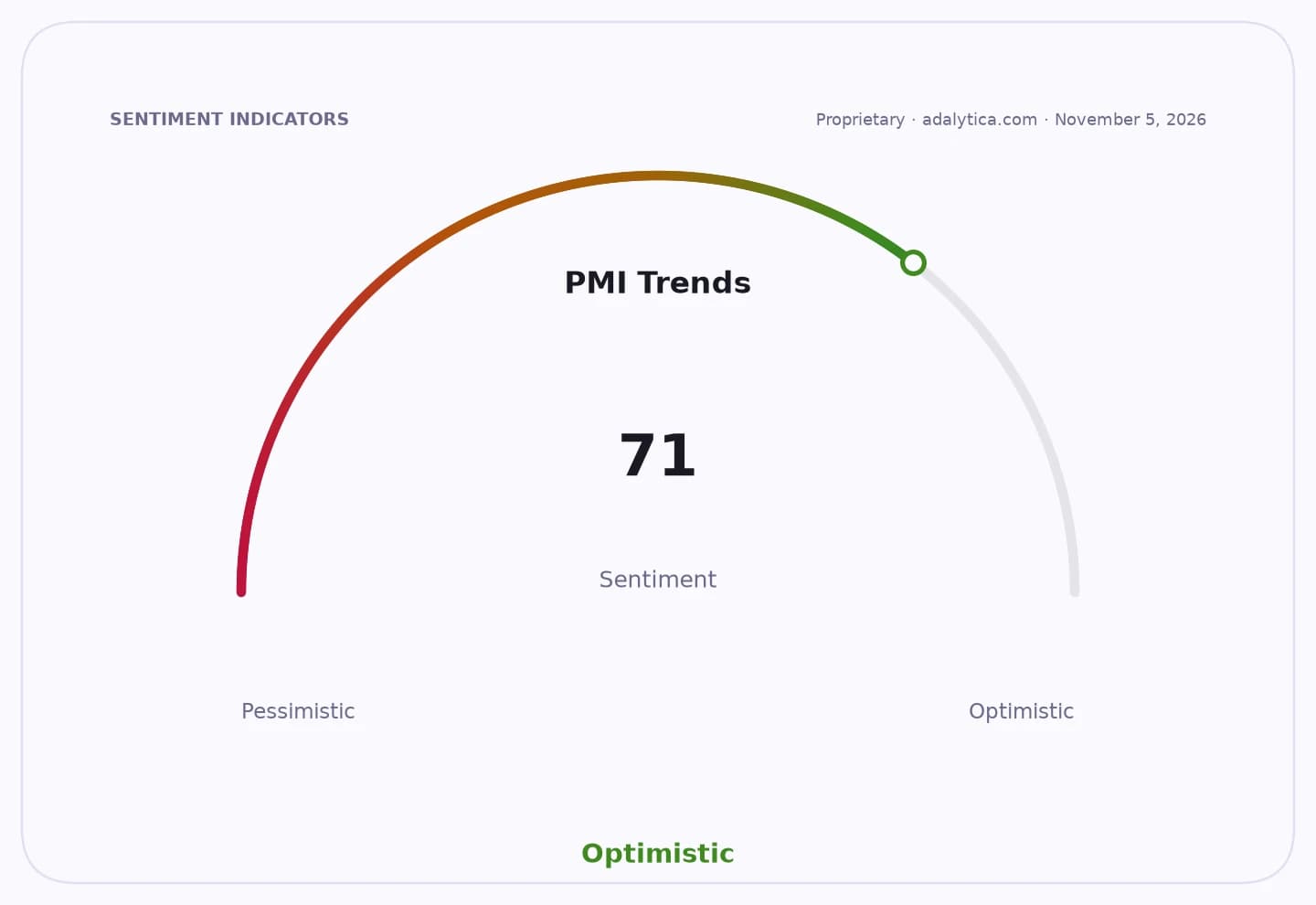
The numbers lend support to that argument. Indonesia’s manufacturing purchasing managers’ index rose to 54 in October 2026, according to S&P Global data cited by the ministry, the strongest expansion in 31 months and well above the 50 threshold that separates growth from contraction. The Ministry of Industry’s confidence index also improved to 53.77 from 51.93 in September, keeping the sector in expansion territory.
PMI Trends vs EIDOadalytica.com
Explore this data interactively — full history, time series and cross-market comparisons.
For policymakers, the significance is twofold. First, it suggests domestic demand remains resilient enough to support industrial output even as some traditional labor-intensive sectors struggle. Second, it implies that the pain is uneven: textiles, textile products and footwear are under pressure, while telecommunications, transport, hotels and restaurants are growing faster.
That divergence is important economically because it shows Indonesia’s recovery is not evenly distributed. A shift in consumption away from traditional goods toward services and mobility-linked spending can still keep aggregate activity firm, but it can also leave parts of the industrial base exposed, especially sectors with thinner margins and more labor intensity. In a country where manufacturing is central to jobs and value-added growth, that gap matters for employment, wages and social stability.
For investors, the data are a reminder that Indonesia’s macro story is more nuanced than a simple demand slowdown. A strong PMI and firmer industrial confidence typically support the case for cyclical exposure to domestic demand, logistics, transport and consumer-facing services. They also reduce pressure for near-term policy easing, while keeping attention on how inflation, credit growth and household spending evolve into year-end.
The market read-through is not unambiguously bullish. If consumption is rotating rather than accelerating, the winners will be firms tied to services and higher-growth urban demand, while exporters and labor-heavy manufacturers tied to older consumption patterns may continue to lag. That split is visible in the government’s own explanation: some sectors are “down,” but activity has moved elsewhere.
The broader signal is that Indonesia’s economy may be rebalancing rather than weakening. The key question for the next few months is whether that shift can broaden into a durable industrial upturn, or whether the gains in PMI and confidence remain concentrated in a handful of stronger subsectors while traditional manufacturing keeps losing ground.
| Entity | Gains | Losses |
|---|---|---|
| Indonesia’s government | ▲Stronger growth narrative | ▼Pressure to defend weak sectors |
| Services sectors | ▲Faster demand growth | ▼— |
| Textile, footwear makers | ▲— | ▼Softer consumer demand |
| Domestic cyclical investors | ▲Better activity backdrop | ▼Labor-heavy manufacturers |