Hong Kong has added another regulated Bitcoin vehicle to its market, with GaoTeng International’s Bitcoin ETF listing on Nov. 20 after Xinhuo Asset Management’s Hong Kong arm committed about $10 million as a cornerstone investor. The debut matters because it gives institutional and retail investors a locally listed route into Bitcoin at a time when the token has been pummeled by heavy selling, underscoring how exchanges and asset managers are still working to turn crypto demand into fee-generating, regulated products.
Hong Kong lists GaoTeng Bitcoin ETF

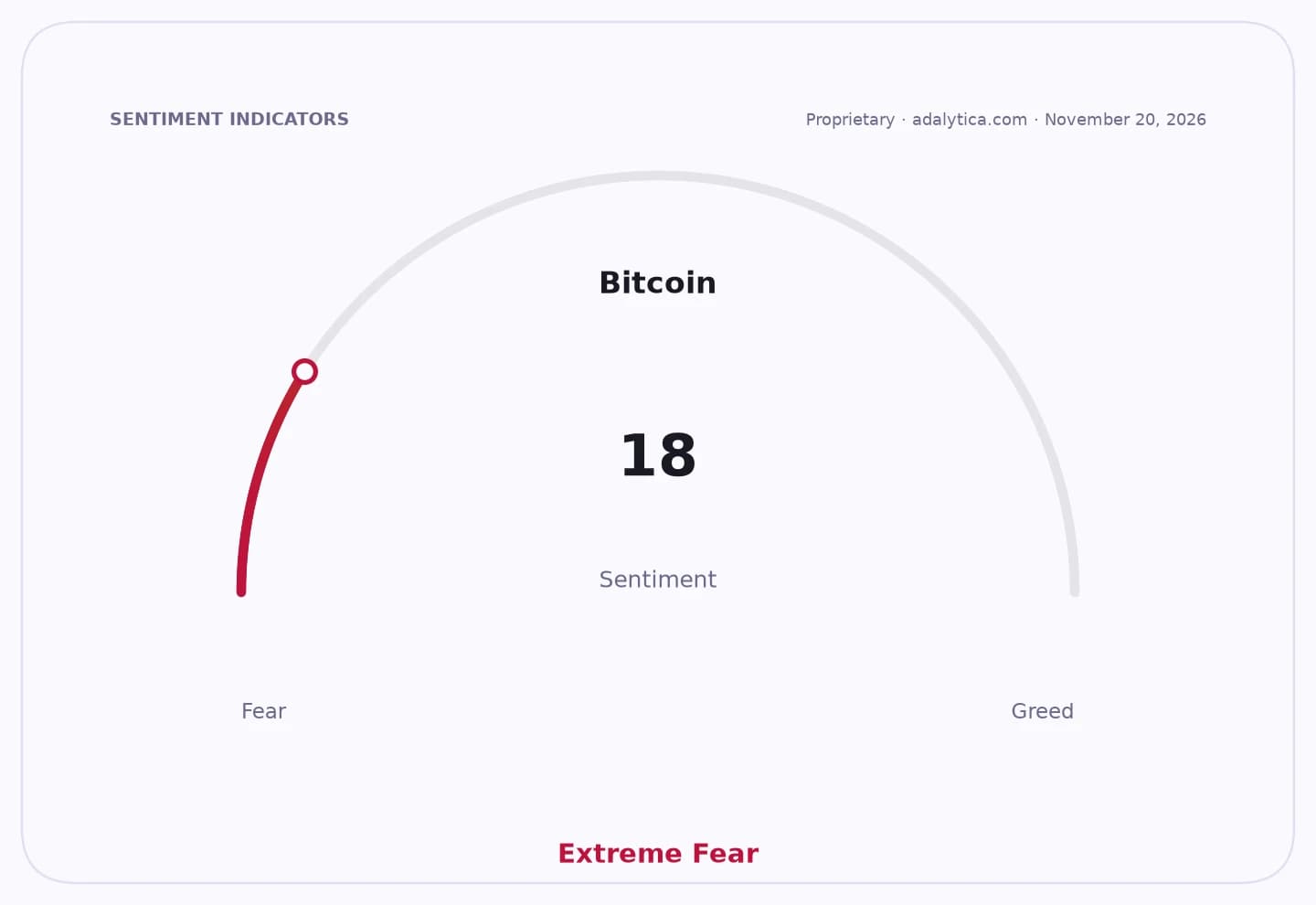
The fund’s listing is another sign that Hong Kong wants to position itself as a digital-asset hub despite the volatility that has shaken the market in recent weeks. Bitcoin fell to around $58,071 on Nov. 21 from $61,902 a day earlier, extending a sharp slide that has left it well below both its 50-day and 200-day moving averages. The 14-day RSI was 9.6, a reading that points to deeply oversold conditions, while Adalytica’s Bitcoin Fear & Greed Index showed sentiment at 20, or “Fear.” Those indicators do not change the fundamentals of the ETF launch, but they frame the timing: the product is arriving into a bruised market, not a euphoric one.
Sentiment Indicators

For GaoTeng and Xinhuo, the economic logic is straightforward. Bitcoin ETFs offer a wrapper that can attract assets from investors who want crypto exposure without managing wallets, custody or exchange risk. The listing gives GaoTeng two trading counters, in Hong Kong dollars and U.S. dollars, broadening access for local and international buyers. For Xinhuo, the $10 million commitment is not just a seed investment but a strategic position in a market that could expand if Hong Kong succeeds in bringing more institutional capital onshore.
The broader implication is that Asian financial centers are competing to capture a slice of crypto’s infrastructure trade. Hong Kong has been pushing to distinguish itself with licensed digital-asset products, while exchanges and managers see tokenized funds and related offerings as the next step beyond plain-vanilla spot exposure. Xinhuo said it plans to work with GaoTeng on digital-asset investment products, institutional services and wealth-management offerings, and the firms also intend to study tokenized funds and other products, subject to regulatory approval. That suggests the ETF is less an endpoint than a foothold in a wider market structure.
Investors will watch whether the ETF attracts meaningful assets despite the current drawdown in Bitcoin and the risk-off mood that has also hit crypto-linked equities. MicroStrategy shares fell to $77.80 on Nov. 20 from $142.54 on Nov. 4, while BlackRock’s U.S. spot Bitcoin ETF, IBIT, dropped to $33.02 from $45.33 over the same stretch, reflecting broad pressure across the asset class. If Bitcoin stabilizes, Hong Kong’s new listing could benefit from a rebound in demand for regulated exposure; if selling persists, the ETF’s first test will be whether it can gather assets in a market where enthusiasm has clearly cooled.
| Entity | Gains | Losses |
|---|---|---|
| GaoTeng International | ▲ETF launch, market presence | ▼Exposure to weak Bitcoin sentiment |
| Xinhuo Asset Management | ▲Strategic stake, product pipeline | ▼Capital tied to volatile asset class |
| Hong Kong exchange | ▲More listed crypto products | ▼Reputational risk if demand stays thin |
| Bitcoin bears / short sellers | ▲Near-term price pressure | ▼Regulated demand growth |