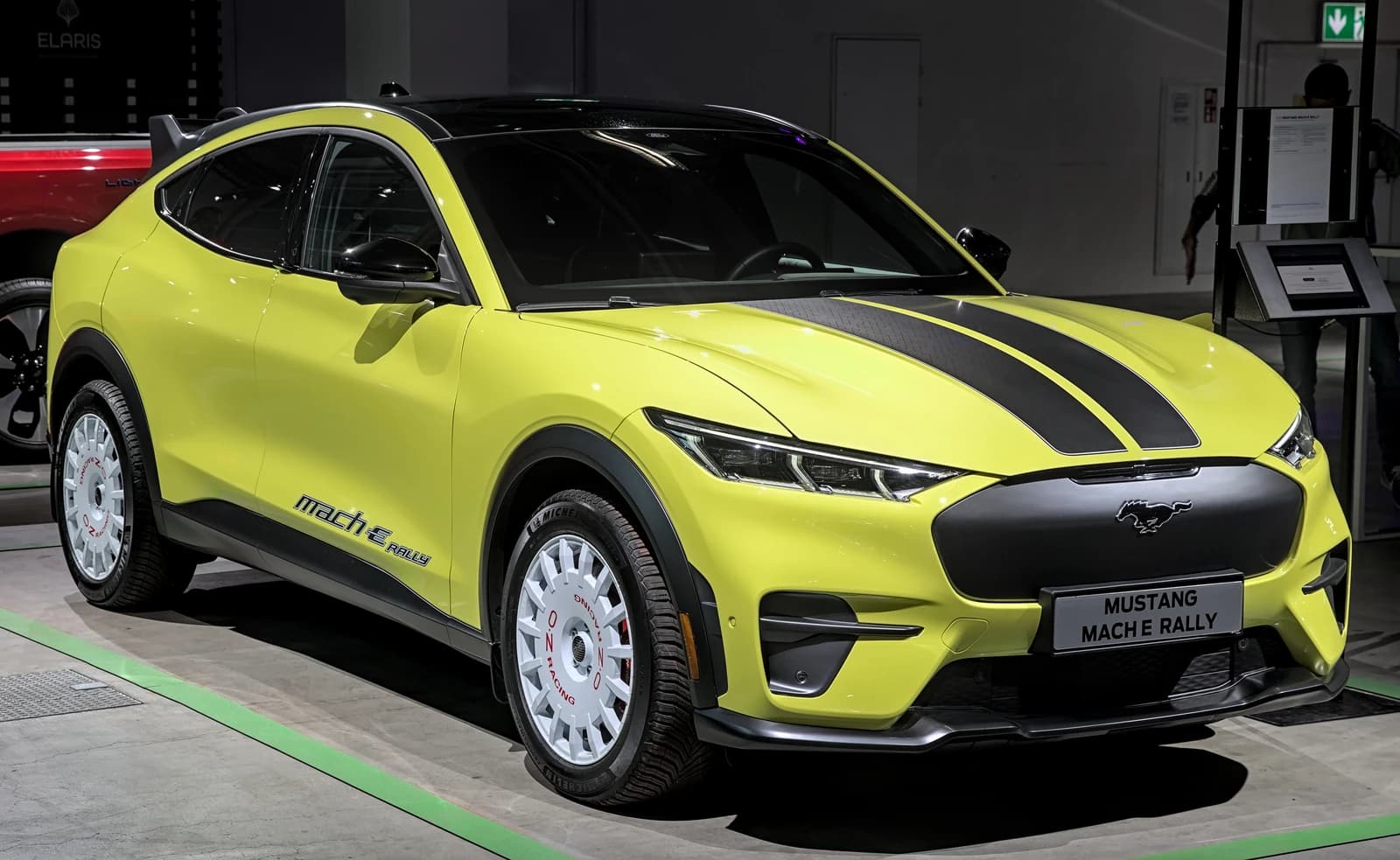
Ford Motor is preparing to bring a four-door Mustang to market as early as the second half of 2028, a move that could revive one of its best-known nameplates while showing investors the company is not done with gasoline-powered performance cars.
Ford plans four-door Mustang for 2028
That matters because Ford is trying to do something the Detroit Three have struggled with for years: make passenger cars that people still want, without repeating the low-margin mistakes of the Focus and Fusion era. The reported sedan, codenamed Mach 4, would broaden the Mustang family beyond the coupe and convertible and give Ford a more practical body style just as buyers have steadily shifted away from two-door cars. Mustang coupe sales in the U.S. have fallen from more than 122,000 in 2015 to about 45,000 last year, a reminder that nostalgia alone does not keep a model alive.
For investors, the key question is not whether Ford can build a four-door Mustang. It is whether Ford can turn a famous badge into a higher-margin business. According to the report, Ford is targeting a starting price below $40,000, sub-4-second 0-to-97 km/h acceleration, and room in the back seat that would outdo the Porsche Panamera. That combination suggests Ford wants this to be a halo car with a broader audience, not a volume sedan that drags on profitability. Chief Executive Jim Farley has made clear Ford wants to re-enter the sedan market only if it can do so profitably.
The engineering choice is just as important. Ford has reportedly walked away from a fully electric platform and instead plans to stretch the rear-wheel-drive S650 architecture used by the current Mustang coupe. That should keep development costs down and preserve the internal-combustion character that Mustang buyers still value. The lineup is said to include a 2.3-liter EcoBoost four-cylinder, a 5.0-liter Coyote V8, and even a hybrid option, with a manual transmission still on the table for the V8. In other words, Ford is trying to keep the emotional appeal of the Mustang while adapting it to a market that now demands more practicality.
That approach also fits a broader industry reset. General Motors has ended Camaro production, Dodge has already brought back the Charger and Challenger nameplates in new forms, and Stellantis has recently relaunched the Charger with gasoline power after an electric version stumbled. If Ford follows through, the Detroit performance wars could get a fresh chapter, with four-door muscle cars becoming a real battleground again.
Ford shares have already shown they can move sharply on product and margin expectations, but the longer-term story is more important than any one launch. A successful Mustang sedan would give Ford another way to monetize a brand with real pricing power, and it could help the company balance its truck-heavy lineup with something more aspirational. The risk, of course, is execution: a car that feels compromised, too expensive, or too late would only underline why Ford left mainstream sedans behind in the first place. For now, though, the reported Mustang sedan looks like the kind of focused, profitable niche product long-term investors should keep on their watchlist.
| Entity | Gains | Losses |
|---|---|---|
| Ford Motor | ▲higher-margin halo car | ▼sedan skeptics |
| Mustang brand | ▲broader appeal | ▼purists |
| GM/Chrysler rivals | ▲renewed rivalry interest | ▼market-share complacency |
| EV-only sedan plans | ▲less near-term pressure | ▼momentum from gas-power revival |