Ethereum’s recovery above $2,700 is strengthening the argument that the network can afford to move faster, with fresh institutional demand and on-chain accumulation giving Ethlabs more room to push for shorter block times without derailing market confidence.
Ethereum Rises Above $2,700 as Block-Time Debate Builds
That matters because block-time cuts are not just a technical tweak. For Ethereum, faster blocks would mean lower latency, quicker transaction finality in practice and a more competitive user experience against rival chains. For investors, the question is whether the network can improve throughput and responsiveness while preserving security and decentralization — a balance that has become more valuable as institutional money returns to the asset.
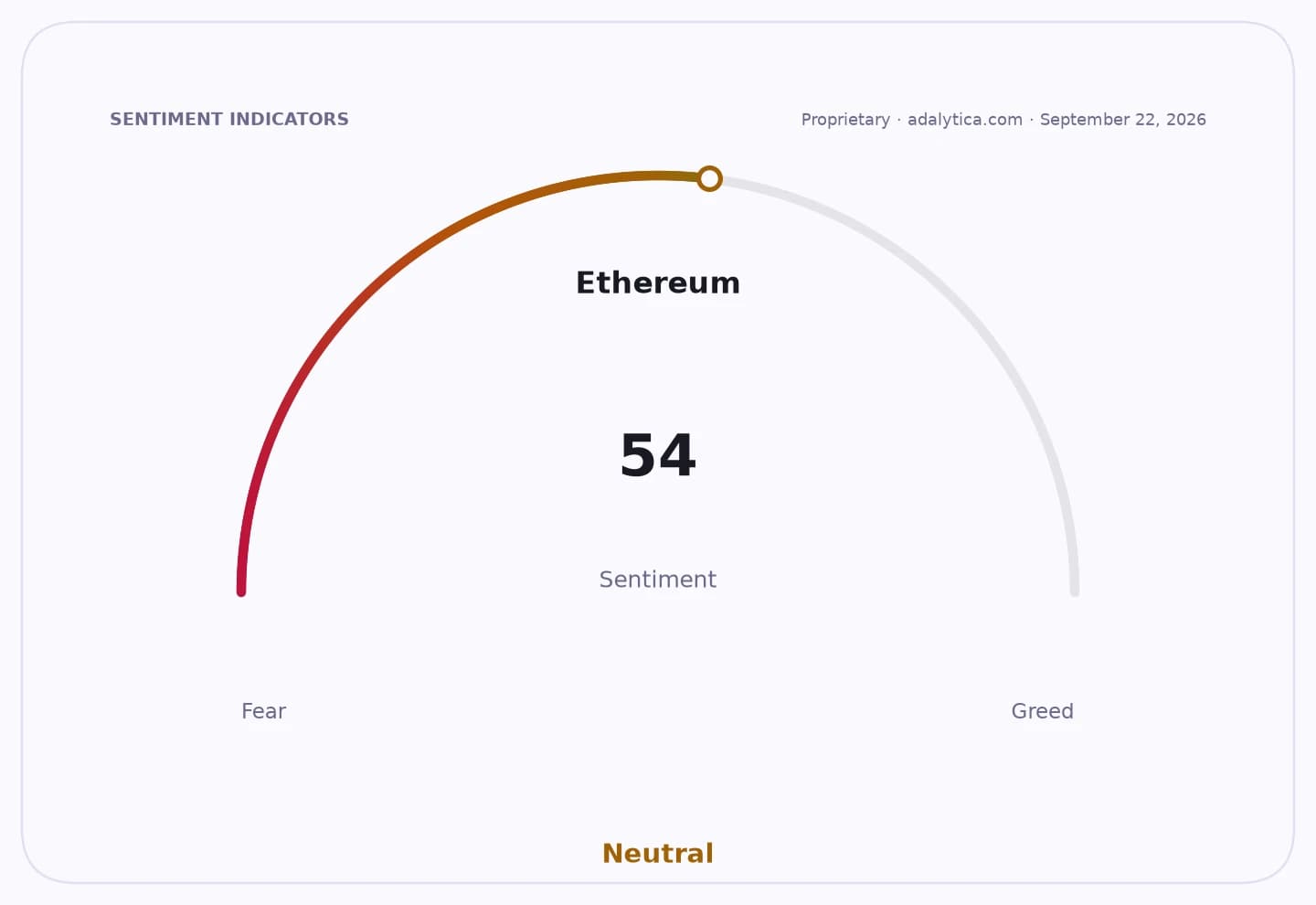
Sentiment IndicatorsⓘProprietary · adalytica.com · September 22, 2026
This is a snapshot — live sentiment, awareness and momentum for 130+ markets update continuously in the dashboard.Open AlphaPulse
The market backdrop is constructive. Ether has climbed from an intraday low near $2,564 on Sept. 20 to $2,728.40 on Sept. 22, briefly testing its Bollinger upper band at $2,728.69, while the 50-day moving average at $2,308.71 remains below spot and the 200-day average at $2,083.40. That configuration points to a recovering trend rather than a broken one. Relative strength has also eased from an overheated 69.8 to 65.9, suggesting momentum remains positive but not stretched.
Volume supports the move. Ether traded more than $24.6 billion on Sept. 22 after $26.5 billion the day before, a sign that the advance is being met by meaningful participation rather than thin weekend flows. Adalytica’s Ethereum gauge shows sentiment at 54, neutral, but awareness at 92, or extreme greed, indicating the market is highly focused on the asset even if positioning is not euphoric. That combination often gives developers and protocol advocates more cover to argue for upgrades that can improve utility.
The institutional angle is the key new information. Bloomberg and Reuters-style market readers would recognize this as the sort of backdrop that can convert a governance proposal from theoretical to investable: stronger demand reduces the risk that a protocol upgrade will be interpreted as a sign of distress. In other words, if capital is entering ETH on ETF-style and broader institutional channels, the market is more likely to tolerate aggressive optimization of the chain’s core plumbing.
For Ethlabs, that is important. A case for faster block times is easier to make when Ethereum is not fighting for survival, and when the asset’s price is holding above major trend markers. The bull case is straightforward: better block times can improve user experience, support higher activity and strengthen Ethereum’s moat against competing layer-1 networks. The bear case is that pushing too hard on speed can create new complexity for validators, increase operational strain or prompt concerns that the network is prioritizing marketable performance over long-term robustness.
The broader crypto tape is also helping. Bitcoin remains firm around $85,414, and its own sentiment gauge sits in greed territory, which tends to support risk appetite across the asset class. If that backdrop persists, Ethereum could keep attracting both speculative and strategic flows, giving Ethlabs and other protocol advocates more momentum for design changes that would have been harder to sell in a weaker market.
The next catalyst is whether institutional inflows continue while ETH holds above the $2,700 area and whether developers can frame block-time cuts as an efficiency upgrade rather than a structural gamble. If the market keeps rewarding Ethereum for utility and resilience, the debate over speed may shift from whether the chain can afford to change to how quickly it can implement it.
| Entity | Gains | Losses |
|---|---|---|
| Ethereum holders | ▲Better network utility | ▼Upgrade execution risk |
| Ethlabs | ▲Stronger case for faster blocks | ▼Higher scrutiny if rollout slips |
| Validators | ▲More network activity | ▼Tighter operational demands |
| Rival layer-1 chains | ▲— | ▼Less relative appeal |