Coal remains a cash-generating corner of the market because power plants and steel mills still burn it, and that stubborn demand is keeping dividend yields high enough to matter for income investors.
Coal Stocks Offer High Yields Despite Risks
Coal
The most important part of the story is not that coal is “back” in a secular sense. It is that the fuel still occupies real, profitable niches in the U.S. energy and industrial system. The Electric Power sector still accounts for roughly 75% of coal disposition in the U.S., according to the Energy Information Administration’s Annual Energy Outlook 2026, while steelmakers continue to rely on metallurgical coal for coke in blast furnaces. That means coal-linked cash flows have not vanished even as the long-term energy transition advances.
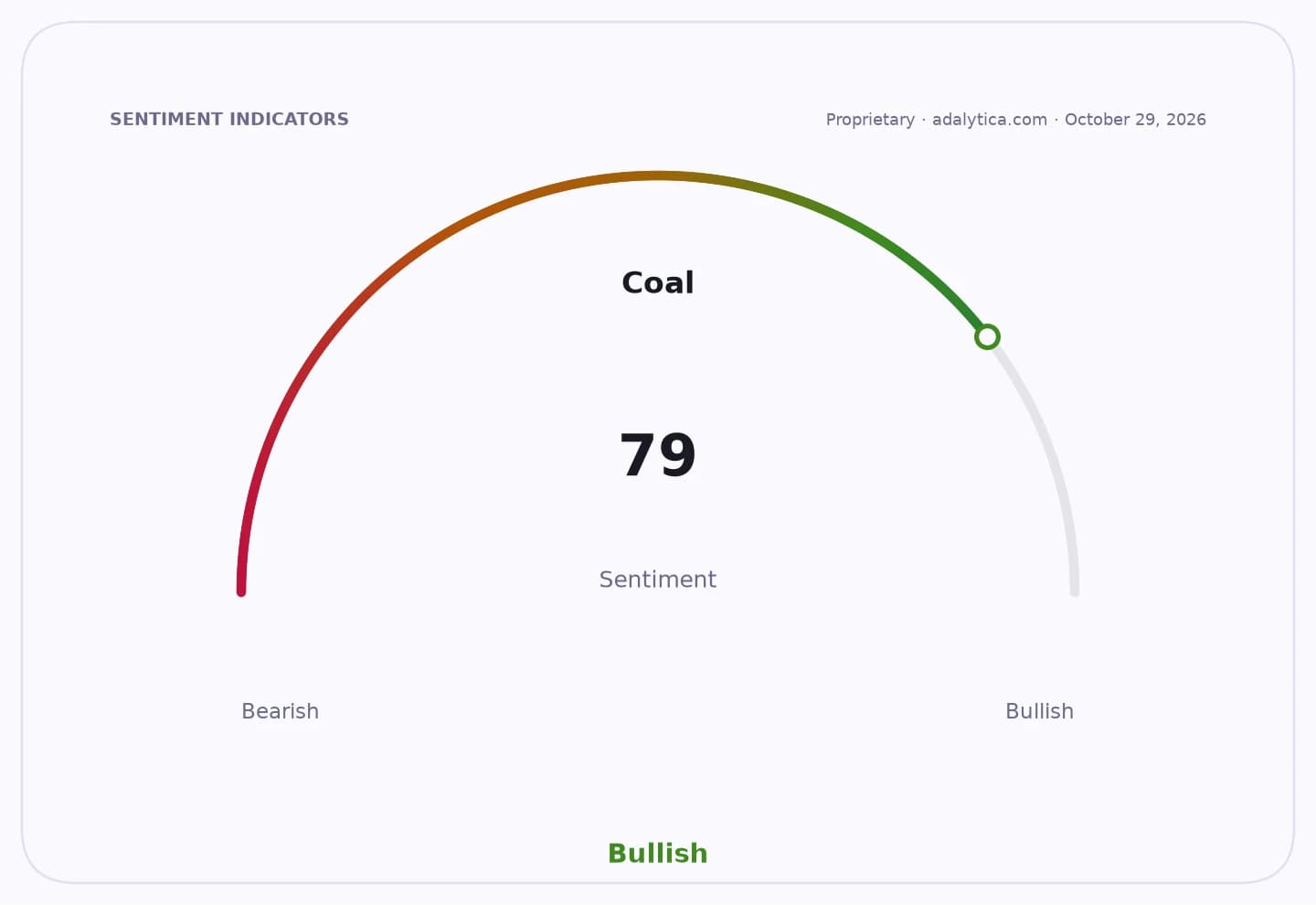
Sentiment Indicators
That durability shows up in the payouts. A $30,000 position in each of Alliance Resource Partners, Natural Resource Partners and SunCoke Energy would total $90,000 and generate more than $5,000 in annual passive income. Alliance Resource, the miner, provides the biggest slice of that income, yielding about 11% and contributing $3,157 of the trio’s $5,893 in yearly distributions. Natural Resource Partners, a royalty owner, yields about 4.05% on a trailing 12-month basis, though its distributions are uneven and investors should not assume November’s $2 payout is a sustainable quarterly run rate. SunCoke, the coke producer, offers the highest operational sensitivity to steel demand but also the most visible contract risk.
That is why income investors are still screening coal names despite the sector’s unglamorous reputation. Coal companies and royalty trusts can return a large portion of operating cash flow to shareholders because capital intensity is lower than in many heavy industries and because commodity prices have held up better than many expected. The appeal is especially strong for retirees and other yield-focused buyers willing to trade growth for current income.
But the trade is not without risk. Alliance and Natural Resource Partners depend on commodity pricing and mine output staying firm enough to support distributions. SunCoke’s key issue is contract renewal: its Granite City agreement expires in December 2026, and management says it is in “active discussions” without yet announcing terms. That makes the next renewal one of the clearest dividend variables in the group.
Coal itself is also cyclical, not a straight-line income machine. U.S. benchmark coal prices have been volatile, and recent industry pricing remains far above levels seen during periods of weak demand, but the market is still exposed to weather, export flows, regulatory pressure and utility switching. On the equity side, Peabody Energy’s shares have already reflected that volatility: the stock, which traded above $39 in March, fell to $15.47 by November 20. Technical indicators such as its 50-day and 200-day moving averages, as well as a deeply oversold RSI reading, suggest the market has already punished the name hard, even as the dividend remains part of the appeal.
The broader investment narrative is therefore less about coal as a growth industry and more about coal as a high-yield cash-distribution asset class that still has a functioning customer base. Bulls will argue that winter demand, industrial steel use and elevated power-sector burn give the sector a floor. Bears will counter that any income advantage can be erased quickly by contract roll-offs, weaker coal realizations or a sharper decline in demand than the market now expects.
For investors, the question is whether the distributions are durable enough to justify the yield premium. For now, coal is still paying, and in a market where many high-yield sectors are tied to leverage or credit risk, that keeps the group relevant.
| Entity | Gains | Losses |
|---|---|---|
| Alliance Resource Partners | ▲Highest income contribution | ▼Commodity and volume risk |
| Natural Resource Partners | ▲Royalty cash flow | ▼Lumpy distributions |
| SunCoke Energy | ▲Steel-linked demand exposure | ▼Granite City renewal risk |
| Income investors | ▲High current yield | ▼Capital appreciation potential |