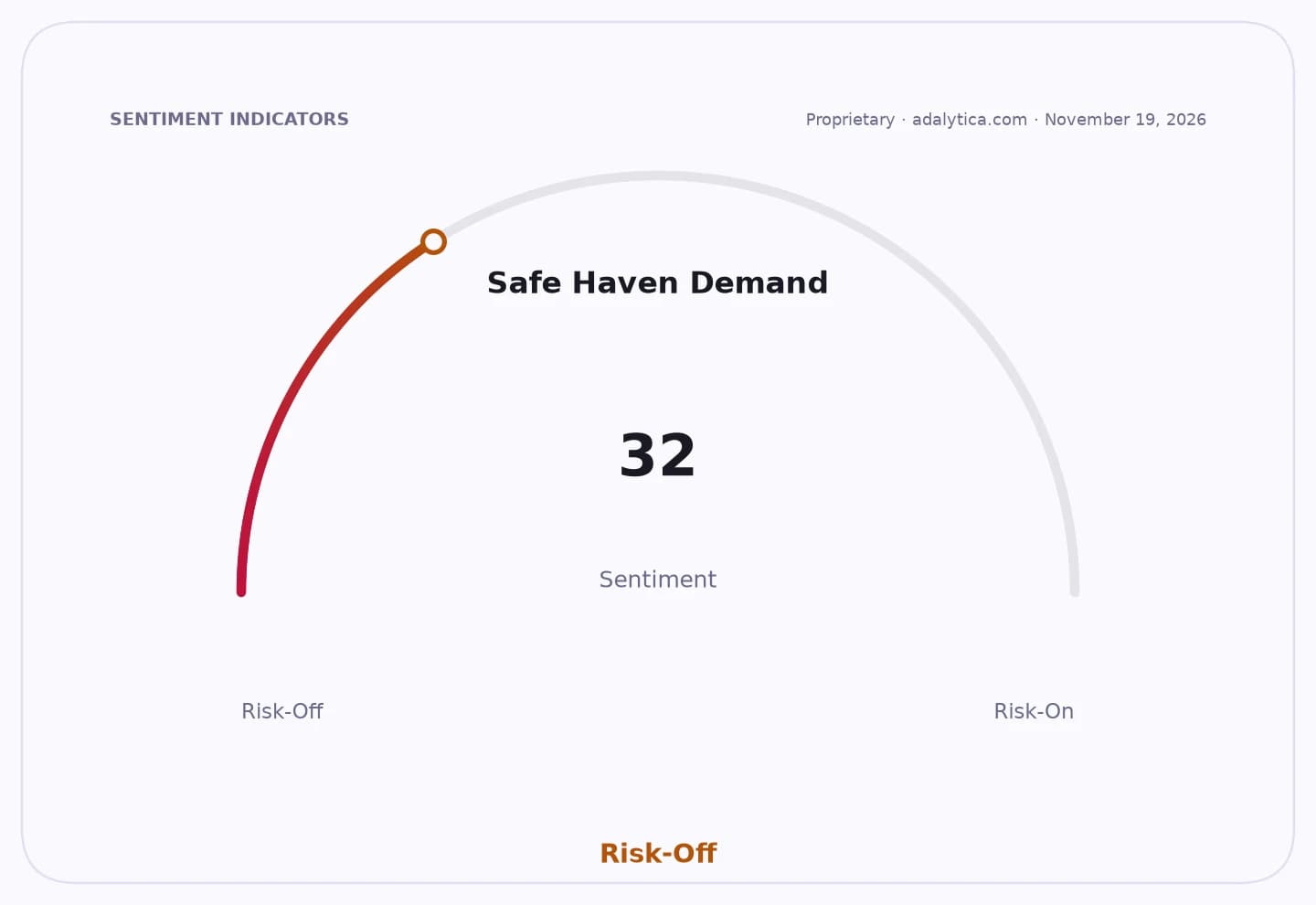
AI is about to make the internet less stable before it makes it safer, and investors are badly underestimating the fallout.
Cloudflare CEO Warns of AI Security Outages
Cloudflare Chief Executive Matthew Prince warned that artificial intelligence could set off a roughly two-year wave of software vulnerability discoveries, rushed patching and system outages as AI finds weaknesses faster than humans can fix them. That matters because the next phase of AI adoption is not just about productivity and revenue growth — it is about operational risk, downtime and the rising cost of keeping critical digital infrastructure online.
Sentiment Indicators
The warning goes straight to the heart of the market’s AI enthusiasm. Every major enterprise now wants more AI in its stack, but AI also lowers the barrier for both defenders and attackers, accelerating the discovery and weaponization of flaws across widely used software. Prince said Cloudflare already sees numerous serious vulnerabilities beyond the recent PHP issues, suggesting the industry has only seen the first domino fall.
That first domino was real. PHP runs on roughly 70% of websites, and vulnerabilities disclosed in October 2026 helped knock multiple major sites and services offline. The pace of disclosures has already outstripped prior years: the National Vulnerability Database says software bugs publicized in 2026 have surpassed all of 2025, while the Electronic Frontier Foundation said 3% of all recorded vulnerabilities surfaced in October alone. In other words, the attack surface is expanding faster than the remediation cycle.
The bigger problem is that the fix can be as disruptive as the flaw. Recent outages affecting companies including Microsoft and United Airlines were tied to hurried patching of AI-discovered vulnerabilities, underscoring a brutal tradeoff: leave a known hole open and risk compromise, or patch quickly and risk breaking the system. That is exactly the kind of failure mode that turns a software problem into a real economic one, hitting airlines, cloud providers, banks, retailers and any business that depends on always-on digital services.
For investors, this is why cybersecurity is not a one-dimensional trade. The market often treats AI as a growth engine for software and cloud, but it is just as powerful a demand driver for security, resilience and incident response. Palo Alto Networks, CrowdStrike and Fortinet sit squarely in that spend cycle, and the recent price action shows how volatile that theme can be: Palo Alto has dropped from above $419 in early October to $343.32, CrowdStrike has slid from $278.86 to $229.44, and Fortinet has fallen from $173.46 to $124.56.
Those pullbacks matter because the underlying thesis has not gone away. If anything, Prince’s warning strengthens it. A prolonged period of AI-fueled vulnerability discovery should force enterprises to spend more on endpoint protection, network security, identity tools, patch management and threat hunting. It also raises the premium on vendors that can help customers withstand outages rather than merely detect intrusions after the fact.
The market is still pricing AI mostly as a race for compute and model scale. The more important second-order trade may be the one around digital resilience. If Prince is right, the next two years could be defined by more outages, more emergency patches and more security budgets — a setup that favors the picks-and-shovels of cyber defense while punishing complacency in software-dependent industries.
| Entity | Gains | Losses |
|---|---|---|
| Cybersecurity vendors | ▲Higher security spend | ▼— |
| Enterprises using legacy software | ▲— | ▼More outages and patching costs |
| Attackers and exploit brokers | ▲More exploitable flaws | ▼— |
| Cloudflare and resilience platforms | ▲Demand for protection services | ▼Operational pressure from incidents |