China’s tech market rout is forcing Beijing into a costly choice: let a speculative AI boom purge excesses, or keep buying time with state-backed support that may distort capital allocation and delay the losses.
China Tech Rout Spurs Beijing Support Debate

The immediate problem is not just the size of the selloff, but what it does to financing conditions for the companies Beijing wants to champion. The STAR50, Shanghai’s technology benchmark, had fallen 40% in less than four months by Oct. 26, wiping out about $480 billion in market value and leaving retail investors nursing heavy losses. More importantly, if that decline feeds through to corporate funding, it could crimp investment, supplier orders and the broader push to build domestic AI and semiconductor capacity.
Sentiment Indicators
That is why the state response matters economically. Goldman Sachs estimated that state-linked investors bought 170 billion yuan of ETF units in October alone, underscoring how Beijing is once again leaning on the market to prevent a disorderly unwind. The China Securities Regulatory Commission has also stepped up stabilization efforts, including through purchases by the so-called national team. But the message to investors is mixed: officials urge discipline while simultaneously socializing the downside.
For markets, the contradiction is the story. A rescue can limit forced selling and ease pressure on listed companies, but it also weakens the discipline that should separate viable AI businesses from those built on policy enthusiasm and speculative capital. The risk is that losses are not resolved, only transferred — into bank balance sheets, public finances and the slower recognition of bad investments.
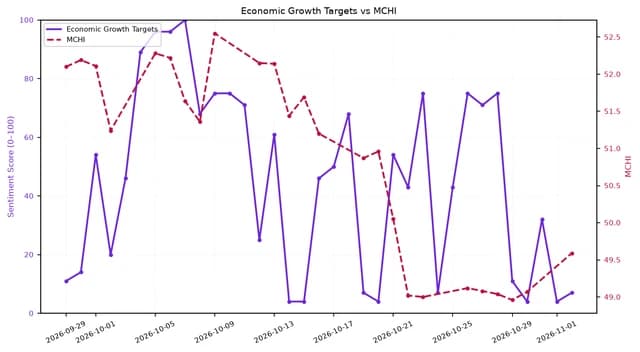
The macro backdrop makes the problem sharper. China’s economy is already split between stronger technology-led investment and weak domestic demand, with property still dragging on growth. In the first nine months of 2026, real-estate development investment fell 20.6%, while high-tech investment rose 4.9% and information services jumped 20.2%. October manufacturing PMI data showed production contracting again, adding to the concern that a tech-market correction could hit one of the few remaining engines of growth.
That leaves Beijing with an unpalatable trade-off. It cannot easily allow a deeper collapse, because the AI race with the US is now a strategic priority and falling behind would increase dependence on foreign technology. But continued support also means backing firms that may not generate enough demand or profit to justify their valuations in the near term. The result is a familiar Chinese policy pattern: stretch out the adjustment, preserve stability, and hope the future growth payoff arrives before the losses become impossible to hide.
Investors are left watching whether the latest support measures merely slow the drawdown or mark the beginning of a more selective state-led restructuring of China’s technology sector. If Beijing chooses to keep capital flowing indiscriminately, the market may stabilize but capital efficiency will deteriorate. If it forces a sharper repricing, the AI story survives, but not every company in it will.
| Entity | Gains | Losses |
|---|---|---|
| State-backed buyers | ▲Buy time for markets | ▼Take balance-sheet risk |
| Retail investors | ▲Some near-term stabilization | ▼Bear valuation losses |
| Stronger AI leaders | ▲Continued funding access | ▼Less if capital is rationed |
| Weak tech firms | ▲Support and rollover financing | ▼Exposure if discipline tightens |