China’s rise as a scientific power is no longer a slogan — it is a measurable shift in the global economy of ideas, and it matters because ideas eventually become patents, products, productivity and profit.
China Fundamental Research Share Rises to 32.6%
A new China Fundamental Research Report says the country’s share of the world’s fundamental research publications jumped to 32.6% in 2024 from just 0.9% in 1985, making China one of the largest generators of basic science in the world. That is not merely an academic milestone. Over time, countries that produce more frontier research tend to capture more of the downstream value in semiconductors, artificial intelligence, advanced materials, biotech and industrial automation.
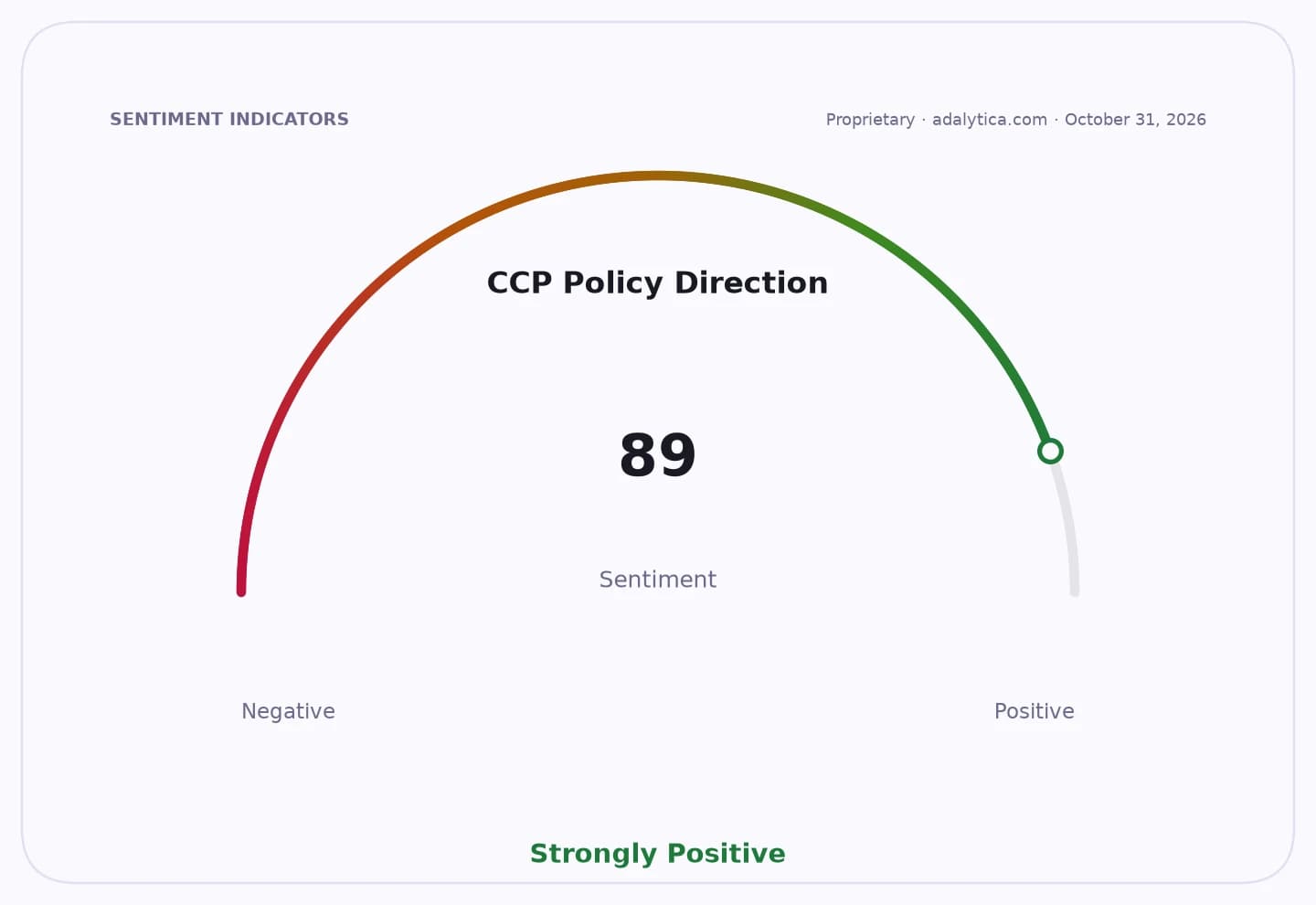
Sentiment Indicators
The report also shows how much the geography of innovation has changed. The United States’ share of global basic research publications fell to 18.9% from 39.9% over the same period, while the European Union slipped to 22.3% from 25.8%. India, meanwhile, increased its share to 7.3% from 2.8%. The message is not that one scientific center has replaced another, but that knowledge production is spreading across more countries — a trend that could broaden the competitive landscape for decades.
For investors, the bigger takeaway is that China’s innovation engine is being built with scale and staying power. Spending on fundamental research nearly doubled from $16.5 billion in 2018 to $31.9 billion in 2023, while the full-time equivalent research workforce surged 148% to 3 million. Those are the kinds of inputs that can support durable gains in national competitiveness, especially when paired with a younger scientist base and stronger support for early-career researchers.
That matters because fundamental research is where many of the most valuable breakthroughs begin, even if the commercial payoff takes years. The report says the share of researchers with at least one NSFC-funded early high-impact publication rose to nearly 80% for the 2019 cohort from about 50% for the 2000 cohort. In plain English: China is not just publishing more, it is cultivating a pipeline of scientists who can keep that output going.
The market implications reach well beyond academia. U.S. and Asian chipmakers, equipment suppliers and AI leaders all depend on where the next generation of technical advances comes from, and China’s growing research base raises the odds that more of those advances will emerge inside its own ecosystem. That could support domestic champions while intensifying competition for foreign firms that rely on Chinese demand, supply chains or collaborations.
Still, the report also highlights an important limit: citation influence has not caught up with publication scale. In 2024, China accounted for 20.8% of citations received worldwide, including domestic citations, versus 24.4% for the U.S. Excluding domestic citations, China’s share of cross-country citations was 9.5%, far below the U.S. at 24.9%. That suggests China’s research system is still translating output into global influence, and that process usually takes time.
For long-term investors, the lesson is simple. China’s research buildout is another reminder that innovation is becoming more geographically distributed, and that the companies and countries best positioned for the next decade will be those closest to the science. The durable winners are likely to be the firms that can convert research into scale, whether in semiconductors, industrial tech, AI or life sciences. This is a trend worth watching — and, for patient investors, worth keeping on the watchlist.
| Entity | Gains | Losses |
|---|---|---|
| China | ▲Larger science base | ▼Slower global citation share |
| United States | ▲Access to more collaborations | ▼Shrinking publication dominance |
| Global investors | ▲New innovation sources | ▼Greater competition in tech |
| Foreign tech rivals | ▲Broader research ecosystem | ▼Tougher race for IP leadership |