Calgary’s housing market is moving into a softer phase, and the biggest risk for investors and homeowners is that higher-density supply is still working its way through the system.
Calgary Housing Market Softens as Condo Supply Builds
The Calgary Real Estate Board said 1,904 homes changed hands in July, down 9.2% from a year earlier, while the benchmark home price slipped 2% to $569,200. The weakest spot was condos and other higher-density housing, where years of heavy construction and a sudden drop in international migration have left the market with too much supply relative to demand.
That matters because Calgary has been one of Canada’s stronger housing markets, supported by population growth, affordability and in-migration. A cooling in transaction volume and falling prices suggests the balance of power is shifting from sellers to buyers, especially in apartment-style properties. Those homes posted an 8.4% annual price decline to $297,600, while row houses fell 6.1% to $418,500. Detached homes proved more resilient, slipping 1.9% to $743,900, and semi-detached prices were nearly flat.
The implications go beyond local real estate. For Alberta’s economy, weaker condo prices can dampen household wealth effects, slow resale-driven spending and pressure developers whose projects were designed for a stronger migration backdrop. The board said Calgary saw 3,323 new listings in July, down 15% from a year ago, and total inventory fell 4.2% to 6,626 homes, showing the market is not in a broad collapse. But the mix matters: if supply is concentrated in apartments while demand shifts back toward detached homes, price dispersion can widen quickly.
For investors, the story is less about a single monthly drop and more about an emerging valuation reset in Canadian housing. The market underestimates how much condo oversupply can squeeze margins for builders, rental landlords and lenders exposed to multi-family assets, while leaving detached housing comparatively firmer. In that kind of environment, the winners are operators with disciplined supply, low leverage and exposure to scarce single-family inventory; the losers are developers and owners leaning on high-density growth assumptions that no longer hold.
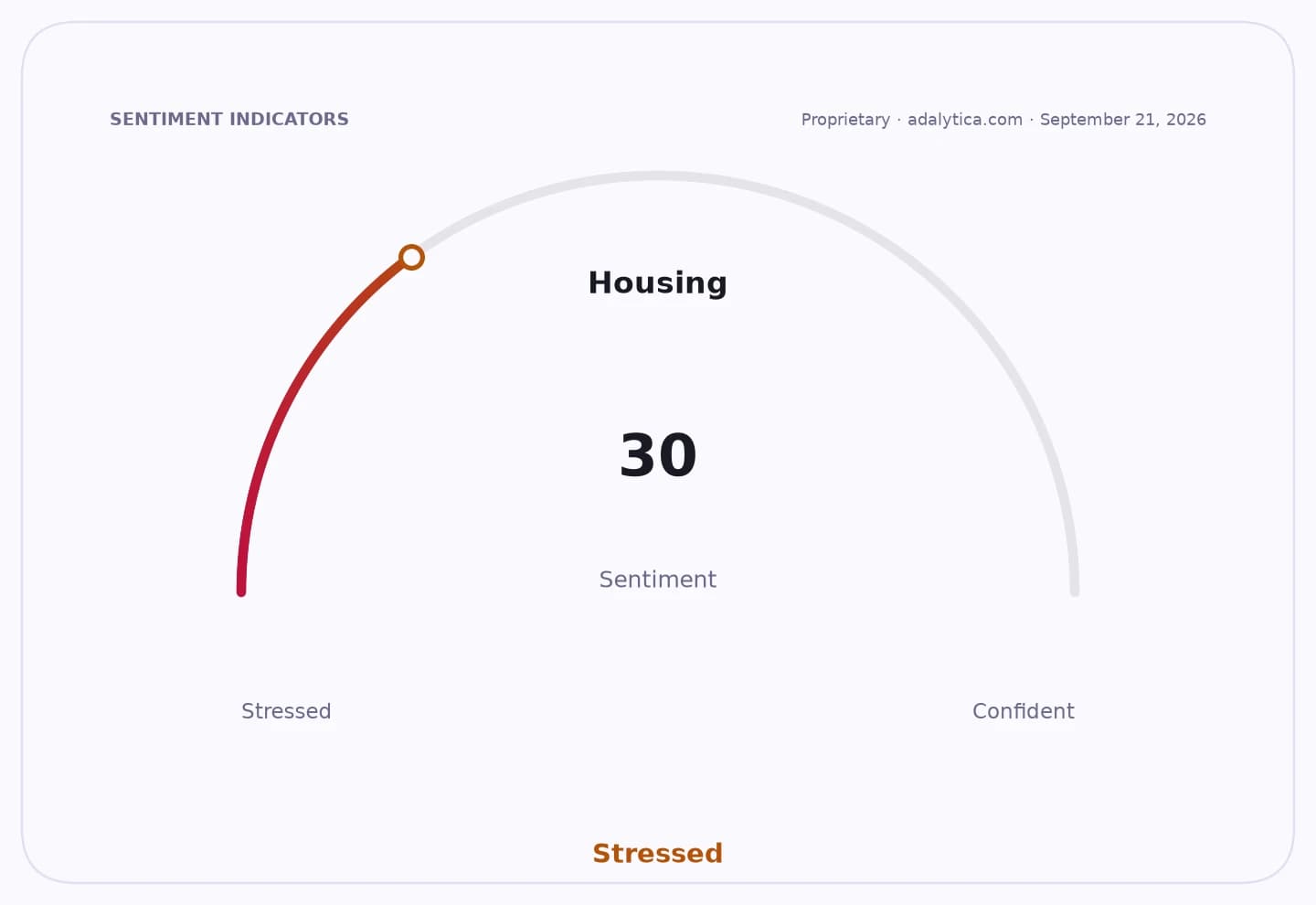
Adalytica’s Housing and Rent Inflation Sentiment gauge currently sits in Fear, reinforcing the view that sentiment around housing and rental inflation has deteriorated sharply. That does not guarantee a crash, but it does support a thesis that pricing power is fading where supply is most abundant.
The key takeaway for investors is to focus on quality and scarcity. Calgary’s housing slowdown is not a reason to abandon the sector, but it is a warning that the next leg of opportunity is likely to come from the parts of the market with the tightest supply, not the most construction.
| Entity | Gains | Losses |
|---|---|---|
| Detached home sellers | ▲Relative pricing power | ▼Less demand spillover from condos |
| Condo buyers | ▲More negotiating leverage | ▼Less urgency to bid |
| Developers of higher-density housing | ▲Little to none | ▼Lower prices, weaker margins |
| Landlords with scarce single-family homes | ▲Tighter supply advantage | ▼Slower resale-driven upside |