Bitcoin’s exchange-traded funds could ultimately grow to three times the size of gold ETFs, and if that happens, the world’s biggest cryptocurrency may be staring at a price range far above where it trades today.
Bitcoin ETFs Could Rival Gold ETF Assets
That is the provocative thesis from Eric Balchunas, Bloomberg’s senior ETF analyst, who says the Bitcoin ETF market could one day pull in roughly $1.85 trillion in assets, compared with about $615 billion in global gold ETF holdings at the end of August. For investors, the implication is simple but enormous: if Bitcoin keeps winning the battle for long-term store-of-value capital, the asset class itself could be revalued many times over.
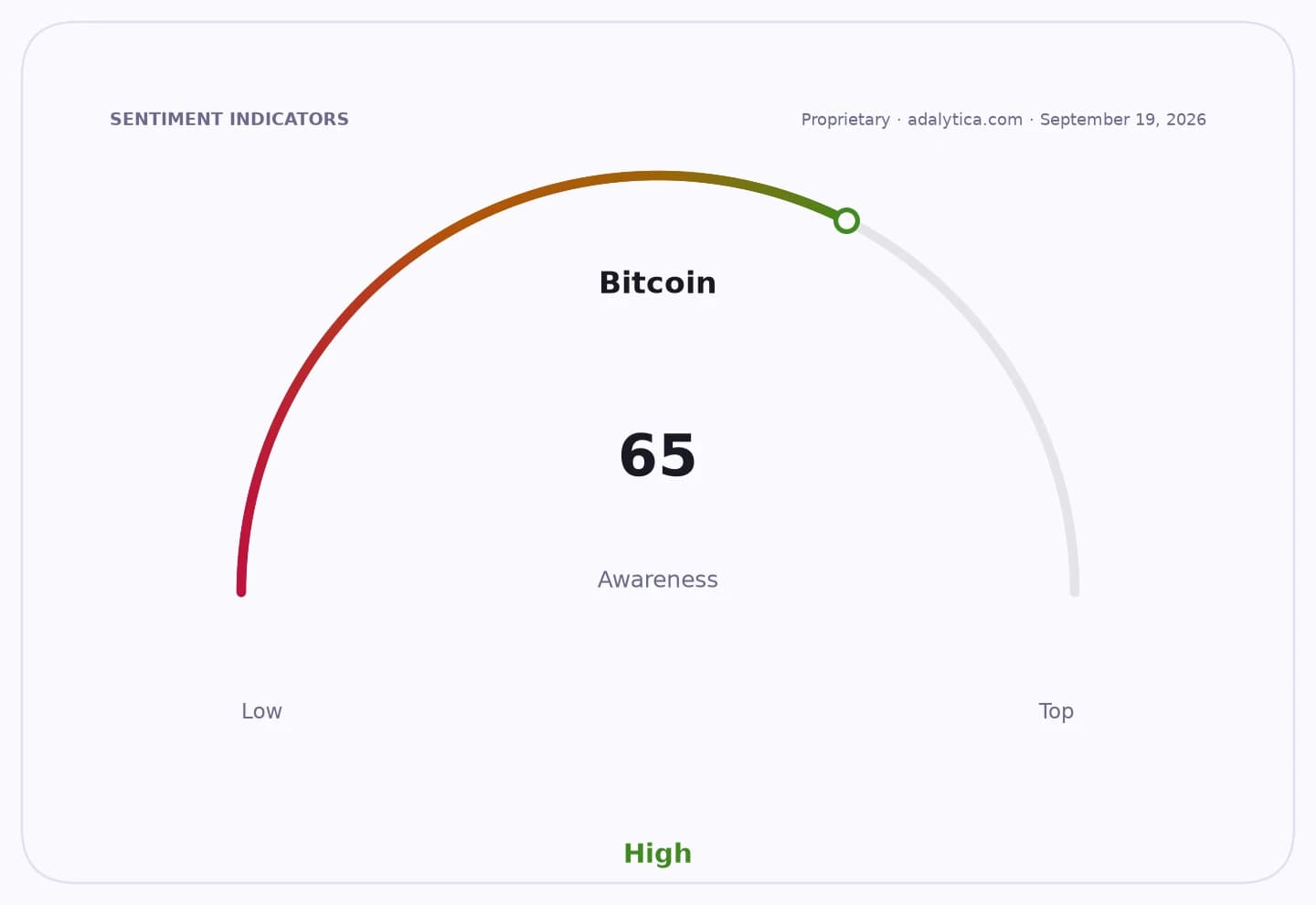
Sentiment IndicatorsⓘProprietary · adalytica.com · September 19, 2026
This is a snapshot — live sentiment, awareness and momentum for 130+ markets update continuously in the dashboard.Open AlphaPulse
The case matters because ETFs are not just another trading wrapper. They are the distribution engine that can turn a niche asset into a mainstream portfolio holding. Balchunas argues that Bitcoin has three structural advantages that gold does not: a younger investor base, more room for institutional adoption, and a powerful on-ramp through firms like BlackRock and Fidelity that can place Bitcoin directly into traditional brokerage and retirement channels. U.S. Bitcoin ETFs have already drawn about $54.6 billion in net inflows since launch, showing that the market is no longer theoretical.
The age profile is especially important for the long run. Younger investors have already shown far greater crypto adoption than older cohorts, and as their wealth grows, so does the pool of capital that may favor Bitcoin over bullion. That is a secular advantage gold cannot easily match. Gold still has the deeper history and the larger global ETF footprint, but Bitcoin’s growth curve may be steeper because it is still early in institutional penetration.
Balchunas’ estimate also underscores how much room remains for institutions to move. Professional investors accounted for only about 21% of U.S. Bitcoin ETF assets in the first quarter, while investment advisers held the equivalent of 150,000 BTC and bank exposure reportedly quadrupled year over year. In other words, this is not a fully matured market. It is a capital pool that could keep expanding as compliance departments, wealth managers and banks become more comfortable recommending Bitcoin to clients.
The price math is where the story becomes eye-catching. U.S. Bitcoin ETFs currently hold about 1.26 million BTC. If the funds doubled their Bitcoin holdings to 2.52 million coins and total ETF assets rose to $1.85 trillion, the implied Bitcoin price would be around $732,000. If holdings tripled to 3.78 million BTC, the implied price would still be roughly $488,000. That suggests a broad long-term range of about $490,000 to $730,000, or roughly six to 10 times the current price.
This is not a formal target, and investors should not treat it like one. ETF assets can grow because more money comes in, because Bitcoin rises, or both. Gold ETF assets may also continue to expand, and Bitcoin ETF adoption could stall if sentiment turns or regulators tighten the screws. But the direction of travel is what matters: if Bitcoin keeps taking share from gold in institutional portfolios, the upside is enormous.
That narrative also fits the market’s recent behavior. Bitcoin has been volatile, but it continues to attract serious capital, and the Adalytica Bitcoin Fear & Greed Index currently sits in neutral territory, suggesting investors are not euphoric even after a recent bounce. Bitcoin trades around $81,735, above its 50-day and 200-day moving averages, while BlackRock’s iShares Bitcoin Trust has also recovered from earlier weakness. Gold, meanwhile, remains a formidable rival near $401 in the GLD ETF, but it lacks Bitcoin’s growth profile and distribution momentum.
For long-term investors, the takeaway is not to chase a price target. It is to recognize that Bitcoin is still in the early innings of a competition with gold for store-of-value capital. If the ETF channel keeps widening and younger investors keep allocating, the asset could compound far beyond today’s expectations. For patient investors building a diversified portfolio, Bitcoin remains worth watching closely — and for believers in the thesis, it may be a long-term buy-and-hold opportunity, not a trade.
| Entity | Gains | Losses |
|---|---|---|
| Bitcoin ETF issuers | ▲Higher assets under management | ▼Lower inflows if adoption stalls |
| Long-term Bitcoin holders | ▲Potential multi-bagger upside | ▼Volatility and drawdowns |
| Gold ETFs | ▲Continued safe-haven demand | ▼Share loss to Bitcoin |
| Financial advisers and banks | ▲New product revenue | ▼Client pushback if BTC underperforms |